What Is the Best Exercise for Heart Health? (Doctor-Backed Guide)
When patients visit my clinic, they constantly ask me a very specific question. They want to know exactly what the best exercise is for heart health to prevent future problems. It seems like everyone is searching for a magic, complicated routine to protect their cardiovascular system. However, as a physician, I can tell you the medical reality is actually quite simple and accessible.
Finding the absolute best exercise for heart health does not require an expensive gym membership or extreme athleticism. Instead, it requires a consistent, daily commitment to moving your body in specific ways. You see, your heart is a muscle, and just like your biceps, it requires regular, targeted stress to grow stronger.
In this comprehensive, evidence-based guide, we will explore exactly what type of exercise is best for heart health. We will cover clinical recommendations, safe home routines, and the physiological science behind building a more resilient cardiovascular system. Let us get your heart pumping and improve your health today.
TL;DR — The Quick Clinical Summary
If you are short on time, here is the exact medical consensus on cardiovascular training. The best exercise for heart health is a combination of moderate-to-vigorous aerobic exercise and routine resistance training.
According to the American Heart Association (AHA) and the World Health Organization (WHO), adults should aim for:
- 150 minutes per week of moderate-intensity aerobic exercise (like brisk walking).
- OR 75 minutes per week of vigorous-intensity exercise (like running or swimming).
- Plus 2 days per week of dedicated strength training for major muscle groups.
What Type of Exercise Is Best for Heart Health?
When evaluating which exercise is best for heart health, the clinical data overwhelmingly point to aerobic activity. Aerobic exercise, commonly known as cardio, forces your heart to pump faster and harder over a sustained period. Consequently, this continuous effort significantly improves your body’s ability to utilize oxygen efficiently.

Over the years, numerous meta-analyses have compared different training modalities. The results consistently show that combining aerobic training with resistance training yields the absolute best cardiovascular outcomes. Here is a breakdown of how different exercises specifically impact your heart.
Cardiovascular Benefits by Exercise Modality
| Exercise Type | Effect on the Heart | Evidence Strength |
| Aerobic (Walking, Running) | Improves VO2 max, lowers blood pressure, and improves endothelial function. | Strong (AHA, WHO Guidelines) |
| HIIT (Intervals) | Rapidly improves cardiac output and insulin sensitivity. | Moderate-Strong |
| Resistance Training | Reduces overall cardiovascular mortality risk when combined with regular cardio. | Moderate |
| Yoga & Flexibility | Reduces stress-mediated cardiac load and lowers resting cortisol levels. | Emerging |
Is Running the Best Exercise for Heart Health?
Many people automatically assume that running is the ultimate gold standard for cardiovascular fitness. While running is undeniably excellent for heart health, it is not necessarily the “best” option for every single patient. In fact, brisk walking provides very similar cardiovascular benefits but carries a significantly lower risk of joint injury.
A landmark study in the Journal of the American College of Cardiology found that moderate running drastically reduces cardiovascular mortality. However, the study also noted that extreme overtraining may actually increase injury risk in previously untrained individuals. Therefore, consistency matters far more than extreme intensity.
From a clinical perspective, I always advise my patients over forty to start slowly. If you have any underlying risk factors, begin with brisk walking and progress very gradually. You should also consider a professional medical stress test if you fall into a high-risk cardiac category.
Can Exercise Strengthen Your Heart?
Patients frequently ask me if they can genuinely change the physical structure of their heart. Yes, regular exercise absolutely strengthens the heart by actively improving cardiac muscle efficiency and overall stroke volume. This means your heart learns to pump much more blood with every single beat.
Because your heart becomes so efficient, your resting heart rate naturally drops. Furthermore, exercise actively improves endothelial function, which allows your delicate blood vessels to dilate and relax properly. This physiological adaptation drastically reduces arterial stiffness and lowers your overall blood pressure.
Clinical trials involving heart failure patients have proven that regular aerobic exercise significantly improves left ventricular function. Furthermore, population studies show that maintaining high physical activity reduces cardiovascular mortality by up to thirty percent. Therefore, the physiological benefits are both profound and undeniable.
5 Best Exercises to Strengthen Your Heart and Lungs
If you want to know the best exercises to strengthen heart function, you must focus on activities that elevate your heart rate. You need to push your heart rate into a specific target zone to trigger healthy adaptations. For moderate exercise, this is roughly 50% to 70% of your maximum heart rate.
To quickly calculate your estimated maximum heart rate, simply subtract your current age from 220. Here are the 5 best exercises to strengthen your heart and lungs safely and effectively:
- Brisk Walking: The most accessible, joint-friendly way to build a massive aerobic base.
- Cycling: Excellent for building leg strength while maintaining a sustained, elevated heart rate.
- Swimming: A phenomenal, zero-impact, full-body workout that heavily taxes your cardiovascular system.
- Rowing: Combines intense upper and lower body resistance with severe aerobic demands.
- Interval Training (HIIT): Short bursts of maximum effort followed by active recovery to quickly boost VO2 max.
Best Exercise for Heart at Home (No Equipment Needed)
You absolutely do not need an expensive treadmill or elliptical machine to protect your cardiovascular system. In fact, finding the best exercise for the heart at home without equipment is incredibly easy if you use your own body weight. You can effectively spike your heart rate in your living room using simple, functional movements.
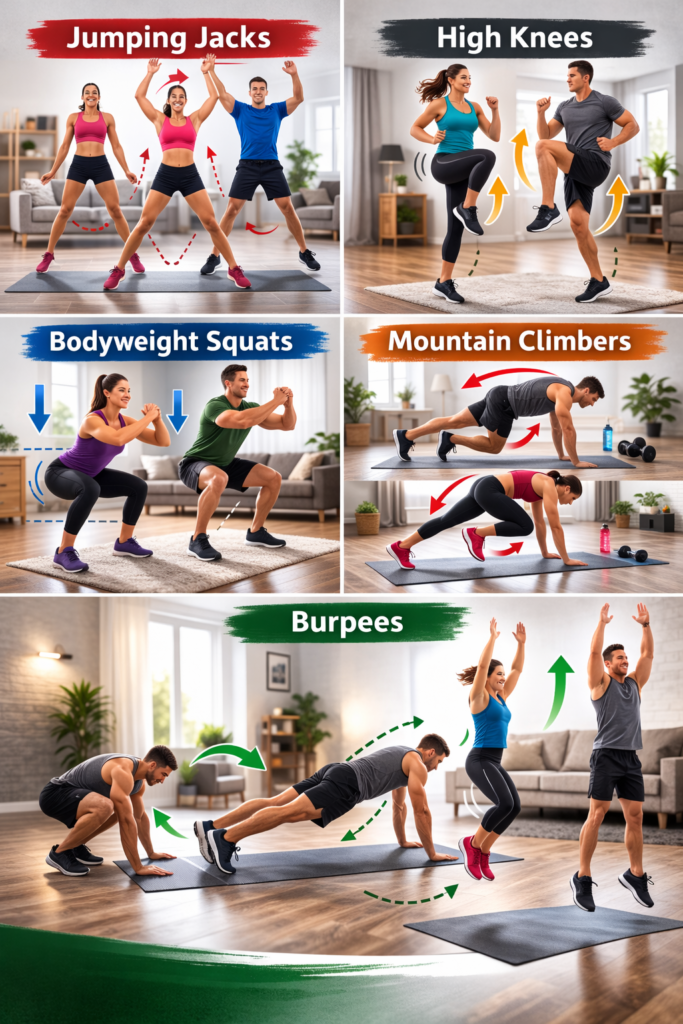
If you want the best exercise for the heart at home, I highly recommend building a simple, fast-paced circuit. Performing compound movements back-to-back forces your heart to work overtime to deliver oxygen to multiple muscle groups simultaneously.
Try this simple, doctor-approved home cardiovascular circuit. Perform each movement for exactly thirty seconds, and repeat the entire cycle three to five times:
- Jumping jacks
- High knees
- Bodyweight squats
- Mountain climbers
- Burpees
Exercises That Increase Heart Rate Quickly
When you want to maximize your cardiovascular fitness, you need routines that push your limits. Therefore, finding exercises that increase heart rate quickly is essential for burning fat and building endurance. Short bursts of intense activity force your cardiovascular system to adapt rapidly.
Furthermore, high-intensity movements significantly boost your metabolism for hours after you finish your workout. If you are healthy and medically cleared, try adding these powerful movements to your routine:
- Sprint intervals: Run at maximum speed for twenty seconds, then walk for one minute.
- Jump rope: A fantastic, inexpensive tool that spikes your heart rate almost instantly.
- Burpees: This full-body movement demands massive amounts of oxygen, driving your heart rate up.
- Cycling intervals: Pedal as hard as possible on a stationary bike for thirty seconds.
As a physician, I always remind my patients to understand their personal heart rate zones. Consequently, you must ensure you have proper medical screening before attempting these rigorous, high-intensity intervals.
Strengthening a Weak Heart Safely
This is perhaps the most critical section of our entire guide. When discussing strengthening a weak heart, safety must always be your primary concern. If you have been diagnosed with heart failure or coronary artery disease, you must consult a cardiologist first.
In my clinical practice, I frequently prescribe structured, supervised cardiac rehabilitation for my high-risk patients. You cannot simply jump into vigorous exercise if your heart muscle is already compromised. Instead, you must focus on very gentle, progressive cardiovascular loading.
The landmark HF-ACTION clinical trial proved that exercise safely improves outcomes in heart failure patients. However, the exact type of exercise matters immensely. Safe options for a weak heart usually include low-intensity walking, stationary cycling, and supervised water aerobics.
Additionally, always pay close attention to your body’s vital warning signals. If you experience sudden chest pressure, severe dizziness, or extreme shortness of breath, stop exercising immediately. Therefore, always prioritize your safety over pushing for a faster mile time.
Improve Heart Health in 30 Days
Many of my patients ask me, “Can you really improve heart health in 30 days?” Surprisingly, the human body is incredibly responsive to positive lifestyle changes. While structural changes to your heart muscle take months, physiological improvements happen remarkably fast.
First of all, start your first two weeks with a very manageable goal. Aim for twenty minutes of brisk walking every single day. In addition, include two days of light resistance training using your own body weight or light dumbbells.
Next, during weeks three and four, gradually increase your total exercise volume. Try to complete thirty to forty minutes of cardio five times a week. Furthermore, add one short, focused interval training session to challenge your cardiovascular capacity.
As a result, you will notice significant improvements by the end of the month. Your resting heart rate will naturally drop, and your blood pressure will likely improve. Most of all, you will experience a massive surge in your daily energy levels.
How Can I Make My Heart Stronger?
Exercise alone is not a magic cure for a poor lifestyle. If you truly want to make your heart stronger, you must adopt a holistic, comprehensive approach to your health. The most successful patients combine physical activity with powerful, evidence-based lifestyle modifications.
Specifically, you need to focus on several core pillars of cardiovascular wellness. First, prioritize a Mediterranean-style diet rich in whole grains, lean proteins, and healthy fats. Additionally, strict weight control significantly reduces the mechanical burden placed on your heart muscle every day.
Finally, never underestimate the devastating cardiovascular impact of chronic stress and poor sleep. High cortisol levels aggressively damage your delicate blood vessels over time. Therefore, adequate sleep and stress management are absolutely vital for long-term cardiac recovery.
What Is the 3-3-3 Rule for Exercise?
Have you seen the latest fitness trends on social media lately? You might be wondering, what is the 3 3 3 rule for exercise that influencers keep mentioning? It is a popular, simplified workout framework designed to help beginners stay consistent without feeling overwhelmed.
The rule generally suggests combining three strength exercises, three cardio intervals, and three core exercises. While this is not an official medical guideline from the American Heart Association, it is incredibly practical. Because it is simple to remember, it helps patients easily build a structured routine.
What Is the Daily 7 Exercise?
Similarly, patients often ask me about the daily 7 exercise protocol. This term usually refers to the famous seven-minute workout, which is a scientifically backed, high-intensity circuit. The American College of Sports Medicine supports this quick, efficient method for busy individuals.
Alternatively, it can also refer to performing seven foundational human movement patterns daily. These include pushing, pulling, squatting, lunging, hinging, rotating, and carrying. Consequently, moving through these seven patterns daily keeps your joints healthy and your heart rate elevated.
List of Cardiovascular Exercises at Home
Are you stuck indoors because of bad weather? You can still get an amazing workout in your living room. Here is a snippet-optimized list of cardiovascular exercises at home that require absolutely zero equipment:
- Fast-paced jump rope (or imaginary jump rope)
- Aggressive marching in place
- Shadow boxing with light dumbbells
- Stepping on your bottom staircase
- High-energy dance workouts
- The skater hops side-to-side
- Plank jacks for core and cardio
Best Exercises to Strengthen the Heart: Evidence Rankings
To make things incredibly clear, let us rank these activities based on clinical evidence. Tier 1 activities have the strongest medical backing for significantly reducing cardiovascular mortality. These include brisk walking, cycling, swimming, and running.
Next, Tier 2 activities offer phenomenal benefits but may carry a slightly higher injury risk for absolute beginners. These include High-Intensity Interval Training (HIIT) and vigorous rowing. Both are exceptional for rapidly improving your overall VO2 max.
Finally, Tier 3 activities serve as excellent, healthy adjuncts to your main cardio routine. For instance, yoga dramatically lowers stress-mediated cardiac load and improves your flexibility. Therefore, combining all three tiers creates the ultimate cardiovascular protection program.
Risks, Contraindications, and When to See a Doctor
While exercise is generally safe, it can occasionally trigger severe, life-threatening cardiac events in vulnerable populations. You must seek immediate medical clearance if you experience active chest pain during physical exertion. Furthermore, do not start a vigorous program if you have completely uncontrolled hypertension.
Additionally, patients with complex diabetes or a family history of sudden cardiac death require a professional evaluation. If you are over forty-five and have been sedentary for years, please schedule a basic stress test. Your doctor wants you to exercise, but we want you to do it safely.
Frequently Asked Questions
What exercise is best for heart health overall?
The absolute best approach is moderate-to-vigorous aerobic exercise performed consistently. Brisk walking for roughly 150 minutes per week provides the most reliable, joint-friendly cardiovascular benefits for the general population.
Is running better than walking for your heart?
Both activities significantly reduce your overall cardiovascular risk and strengthen your heart muscle. However, running is simply more time-efficient, allowing you to burn more calories in a much shorter period.
Can exercise completely reverse heart disease?
Exercise dramatically improves your cardiovascular risk factors and significantly strengthens your heart muscle. Nevertheless, it is a powerful management tool, not a magical, complete cure for severe, advanced coronary artery disease.
How fast can I improve my heart health?
You can actually see measurable, positive changes in your blood pressure and resting heart rate in just two to four weeks. However, significant structural changes to your heart muscle require many months of consistent training.
How often should I lift weights for my heart?
The American Heart Association officially recommends performing dedicated resistance training at least two days per week. Lifting weights actively reduces your overall cardiovascular mortality risk when combined with regular aerobic exercise.
Conclusion
In conclusion, taking control of your cardiovascular wellness is the most important medical decision you can make. The scientific evidence is absolutely undeniable. Regular, consistent physical activity dramatically lowers your risk of heart attacks, strokes, and early mortality.
You do not need to become an Olympic athlete to see massive, life-changing benefits. Start slowly, listen carefully to your body, and gradually increase your physical intensity over time. Furthermore, always prioritize finding an activity that you genuinely enjoy doing every single day.
Ultimately, finding the best exercise for heart health simply means finding the one you will actually stick with. Want a personalized, highly effective heart-health exercise plan? Talk with your healthcare provider today, and consider downloading a free 30-day heart health tracker PDF to begin your journey.
Evidence-Based References:
- American Heart Association (AHA) — Recommendations for Physical Activity in Adults
- National Heart, Lung, and Blood Institute (NHLBI) — Physical Activity and Your Heart
- World Health Organization (WHO) — Physical Activity Fact Sheet
- American College of Cardiology (ACC) — CardioSmart: Exercise and Physical Activity
- Centers for Disease Control and Prevention (CDC) — Physical Activity Basics
Related Posts






MORE from Author
Read More As a physician, I regularly see patients who are utterly exhausted from poor sleep. When you are desperately scrolling online…
- Hey, there. Let's talk about something we all want but struggle to achieve: vibrant, long-term health. These days, figuring out…


 Every week in my clinical practice, patients ask me the same desperate question: "Doc, how do I actually prevent a…
 When patients visit my clinic, they frequently ask me, "Doc, what is a healthy lifestyle, really?" They feel completely overwhelmed…