What Your Resting Heart Rate Says About Your Health (By Age & Gender)

In my clinical practice, patients frequently ask me to interpret the data on their smartwatches. They stare at the numbers on their wrists and nervously ask, “Doc, what does your resting heart rate tell you about your general health?” This is a fantastic question because your pulse is one of the most accessible and vital biomarkers we have.
Your resting heart rate (RHR) is the number of times your heart beats per minute while you are completely at rest. It is a powerful, real-time indicator of your cardiovascular fitness, nervous system balance, and overall physical recovery. Consequently, understanding what your resting heart rate says about your health is crucial for long-term disease prevention.
While a single reading provides a quick snapshot, tracking your daily trends reveals a comprehensive story about your internal health. In this detailed clinical guide, we will explore exactly what a resting heart rate says about your health, including normal ranges, danger zones, and evidence-based ways to improve it.
TL;DR — Quick Heart Rate Summary
If you are short on time, here is the clinical summary of what your resting heart rate indicates.
- Your resting heart rate (RHR) actively reflects your cardiovascular fitness, daily stress load, and overall heart health.
- Most healthy adults naturally fall between 60 and 100 beats per minute (bpm).
- However, highly conditioned athletes often possess a resting heart rate between 50 and 70 bpm.
- A consistently high resting heart rate may signal increased cardiovascular risk, severe dehydration, or underlying metabolic stress.
- Conversely, lower resting rates generally indicate superior heart efficiency and parasympathetic nervous system dominance.
What Is a Normal Resting Heart Rate?
When a new patient sits on my exam table, checking their pulse is always one of the very first physical assessments I perform. Many people want to know exactly how to determine if their heart rate is normal. The clinical definition of a normal resting heart rate for adults ranges strictly from 60 to 100 beats per minute (bpm).
However, “normal” does not always equate to “optimal” in modern preventative cardiology. According to the American Heart Association (AHA), well-conditioned individuals often maintain a resting heart rate between 50 and 70 bpm. To measure yours accurately, sit quietly for at least five minutes, completely relaxed, before taking a reading in the morning.
What Your Resting Heart Rate Says About Your Health
Your heart is a complex muscular pump directly controlled by your autonomic nervous system. Therefore, the speed at which it beats while you are sitting still provides massive insight into your underlying physiology. Here is a detailed clinical breakdown of exactly what a resting heart rate says about your health.
1. Cardiovascular Efficiency & Stroke Volume
A lower resting heart rate strongly indicates superior cardiovascular efficiency. When you perform regular aerobic exercise, your heart muscle physically grows more robust. Consequently, it pumps a much larger volume of blood with every single beat, a metric we call “stroke volume.”
Because the heart is pumping more blood per beat, it simply does not need to beat as often to supply your body with oxygen. Therefore, a low resting heart rate means your heart is working smarter, not harder. This increased efficiency dramatically reduces the mechanical wear and tear on your cardiac muscle over a lifetime.
2. Longevity & Overall Mortality Risk
Patients often ask, “What does your resting heart rate tell you about longevity?” The medical data on this specific correlation is incredibly compelling. Multiple large-scale meta-analyses demonstrate that a higher resting heart rate is directly associated with an increased risk of all-cause mortality.
Specifically, clinical studies suggest that resting heart rates consistently above 80 or 90 bpm may signal underlying systemic inflammation or endothelial dysfunction. Conversely, maintaining a resting heart rate in the lower end of the normal range (60-70 bpm) is a strong predictor of a longer, healthier lifespan. Evidence Grade: Moderate-High.
3. Stress & Nervous System Balance
Your heart rate is directly governed by two competing branches of your autonomic nervous system. The sympathetic branch acts as the “gas pedal,” speeding up your heart during times of acute physical or psychological stress. Conversely, the parasympathetic branch acts as the “brake pedal,” slowing your heart down during rest and digestion.
If your resting heart rate is chronically elevated, it clearly indicates sympathetic dominance. This means your body is stuck in a constant “fight or flight” state due to chronic stress, poor sleep, or massive caffeine intake. Therefore, lowering your resting pulse is a primary goal of effective stress management.
4. Current Physical Fitness Level
Finally, your resting pulse is one of the most reliable, easily trackable markers of your current physical fitness. Professional endurance athletes frequently have resting heart rates in the 40s or even high 30s. If you begin a new cardiovascular training program, you should see your resting heart rate gradually drop over several months as your fitness improves.
Normal Heart Rate by Age (With Charts)
Because human physiology changes drastically throughout our lifespan, a “normal” pulse is highly age-dependent. Parents frequently panic when they see their toddler’s rapid heart rate, not realizing that children’s hearts naturally beat much faster than adults’. If you are searching for a normal heart rate by age, you must use age-adjusted clinical charts.
A newborn baby’s heart must beat incredibly fast to sustain their rapid metabolic growth and small stroke volume. As we transition into our teenage years, our heart muscle enlarges, and our resting pulse gradually slows down to adult levels.
Resting Heart Rate Chart by Age
| Age Group | Normal Resting HR (bpm) |
| Newborns (0-1 month) | 100–160 bpm |
| Children (1–10 yrs) | 70–120 bpm |
| Teens (11-17 yrs) | 60–100 bpm |
| Adults (18+ yrs) | 60–100 bpm |
| Older Adults (65+ yrs) | 60–100 bpm |
What Is a Good Resting Heart Rate by Age and Gender?
Beyond age, biological sex plays a significant role in cardiovascular baseline metrics. Many female patients ask me, “What is a normal heart rate for women, and why is it higher than my husband’s?” This is a well-documented physiological phenomenon, not an indicator of poor health.
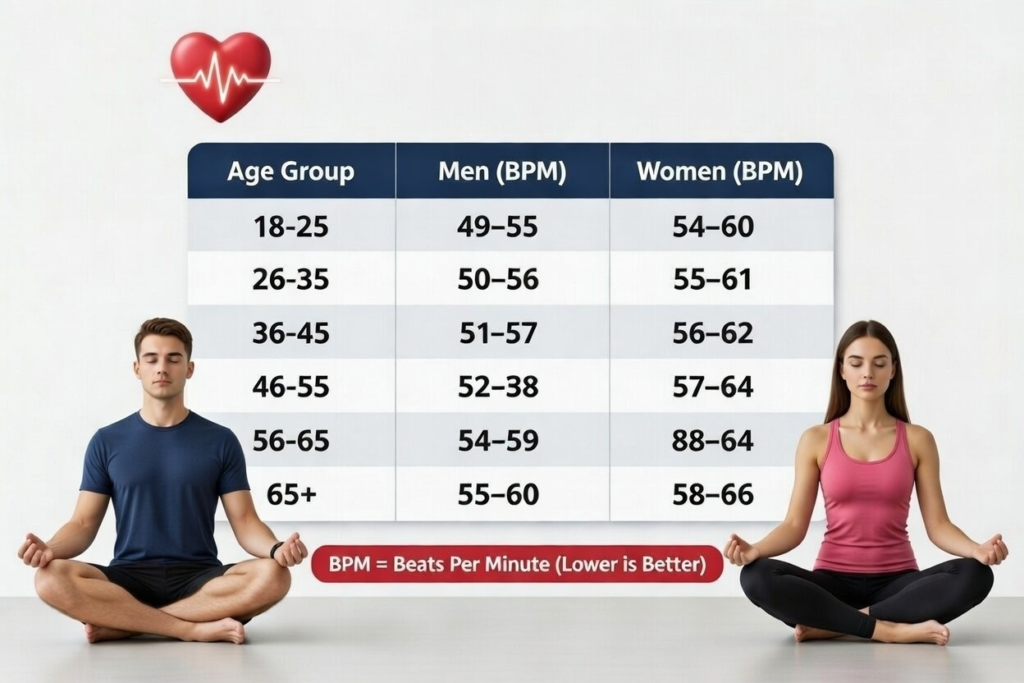
When examining what a good resting heart rate is by age and gender, women naturally average slightly higher resting rates than men. This difference is typically between two and seven beats per minute. The primary reason is that women generally have a smaller physical cardiac size, requiring the heart to beat slightly faster to maintain adequate cardiac output.
Furthermore, hormonal fluctuations throughout the menstrual cycle and during menopause can temporarily elevate a woman’s resting pulse. Therefore, a normal heart rate by age women’s chart will always reflect these slight biological elevations compared to men.
Average Resting Heart Rate by Gender
| Gender Group | Average RHR |
| Adult Men | 60–72 bpm |
| Adult Women | 65–78 bpm |
Is a Resting Heart Rate of 75 OK?
Patients frequently send me messages on their patient portal asking, “Doc, is a resting heart rate of 75 ok?” They often worry after reading fitness blogs that claim everyone must have a pulse in the fifties. However, as a physician, I can assure you that you do not need to panic.
Yes, a resting heart rate of 75 bpm is absolutely within the normal adult range of 60 to 100 bpm. Furthermore, it represents a perfectly adequate baseline for the vast majority of the general population. If your pulse sits at 75 and you feel energetic, your heart is likely functioning very well.
However, long-term cardiovascular studies do suggest that slightly lower resting rates (between 60 and 70 bpm) are associated with better longevity outcomes. Therefore, while 75 bpm is perfectly fine, optimizing your routine to drop it closer to 65 bpm provides excellent preventative benefits. Always remember that context matters; your current fitness level and daily medications will heavily influence this number.
What Is a Dangerous Heart Rate?
While minor fluctuations are perfectly normal, you must recognize when your pulse indicates a true medical emergency. Many patients ask me, “What is a dangerous heart rate, and when should I call 911?” Generally, we divide dangerous resting heart rates into two specific clinical categories: bradycardia and tachycardia.
First, a dangerously low heart rate is called bradycardia. If your resting pulse drops below 50 bpm and you are not a highly trained athlete, this is highly concerning. Furthermore, if this low pulse is accompanied by severe dizziness, extreme fatigue, or fainting, you need immediate medical attention.
Conversely, a dangerously high pulse is called tachycardia. If you want to know what a dangerous heart rate is for a woman or a man, look for a persistent resting pulse above 100 bpm. Consequently, if your heart is racing at rest and you experience crushing chest pain or shortness of breath, please call emergency services immediately.
What Does Your Resting Heart Rate Tell You About Your General Health?
Your pulse acts as a brilliant, non-invasive window into your entire metabolic system. Therefore, what does your resting heart rate tell you about your general health beyond just cardiovascular fitness? Surprisingly, a chronically elevated pulse is one of our best early warning signs for several systemic issues.
For example, a sudden spike in your resting heart rate often indicates high levels of systemic inflammation or an incoming viral infection. Additionally, patients suffering from metabolic syndrome or prediabetes frequently exhibit higher resting pulses due to chronic physiological stress.
Furthermore, your thyroid gland directly controls your heart’s pacing. An overactive thyroid (hyperthyroidism) will rapidly accelerate your resting pulse, while an underactive thyroid typically slows it down. Finally, a high morning pulse strongly indicates poor sleep quality or severe nighttime dehydration.
Importance of Resting Heart Rate
The true importance of resting heart rate lies in its absolute simplicity and reliability as a daily biomarker. You do not need expensive lab tests to track this vital metric; a simple smartwatch or two fingers on your wrist works perfectly. Here are the top reasons why monitoring your pulse is clinically essential:
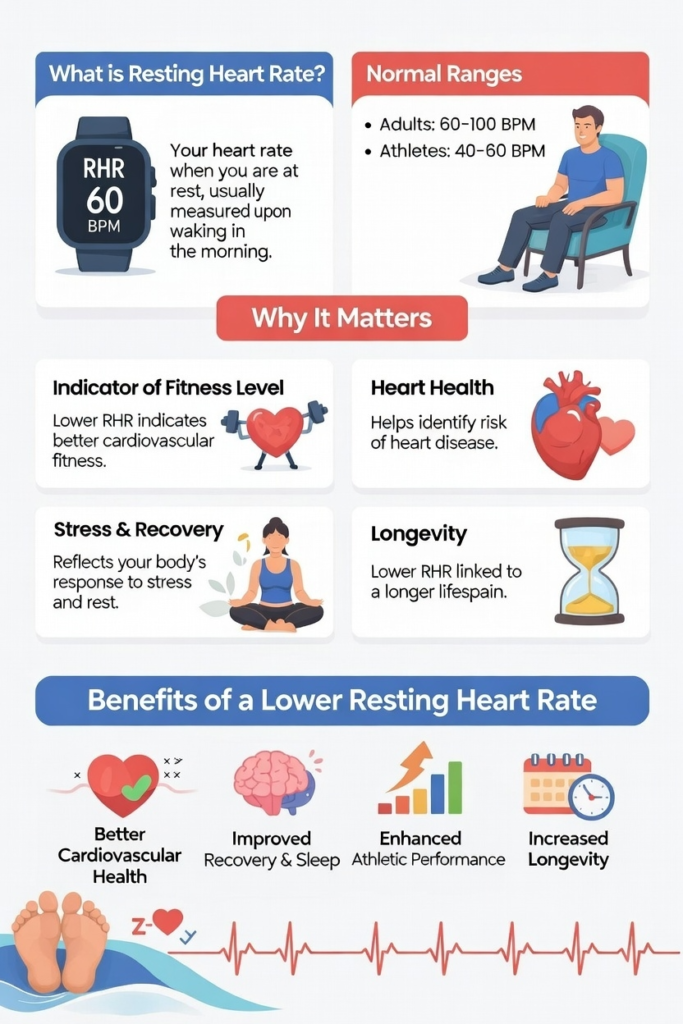
- Early Risk Signal: It quickly flags potential infections, severe dehydration, or dangerous overtraining.
- Fitness Tracking: It provides hard, objective data showing that your cardiovascular capacity is improving.
- Recovery Marker: It tells you exactly when your nervous system has fully recovered from a heavy workout.
- Stress Indicator: It clearly highlights when your daily psychological stress is physically damaging your body.
By consistently tracking your pulse, you can make informed decisions about your weight management journey, your nightly sleep optimization, and your daily stress management routines.
Resting Heart Rate vs Target Heart Rate
Many beginners confuse their resting baseline with their active exercise zones. When patients ask me, “What is the difference between a resting and a target heart rate?” I explain that they measure completely different physical states. Your resting pulse measures your engine at an absolute standstill, while your target pulse measures your engine under a heavy load.
To find your optimal exercise zone, you must first calculate your maximum heart rate by age. You can estimate this by simply subtracting your current age from the number 220. Your target heart rate for effective aerobic conditioning should sit between 50% and 85% of that maximum number.
Heart Rate Comparison Table
| Type | Clinical Meaning | Typical Range |
| Resting HR | The heart beats while completely at rest | 60–100 bpm |
| Target HR | Optimal cardiovascular exercise zone | 50–85% of max |
| Maximum HR | Estimated maximum physical effort | 220 minus your age |
How to Lower Resting Heart Rate (Evidence-Based)
If your daily pulse is sitting in the high 80s, you actively hold the power to bring it down. When patients ask me how to lower their resting heart rate safely, I prescribe specific lifestyle interventions before ever writing a pharmaceutical prescription. Here are the most effective, evidence-based medical strategies to optimize your heart’s efficiency.
1. Aerobic Exercise (Strong Evidence): Consistent cardiovascular exercise is the absolute best way to lower your pulse. Aim for 150 minutes of moderate aerobic activity, like brisk walking or cycling, every single week. This directly improves your VO2 max and physically strengthens your heart muscle.
2. Resistance Training (Moderate Evidence): Lifting weights two to three times a week significantly improves your overall metabolic health. While not as direct as cardio, building lean muscle reduces the daily mechanical strain on your cardiovascular system.
3. Strategic Weight Reduction: Carrying excess body fat forces your heart to work much harder just to pump blood through miles of extra tissue. Therefore, losing even five to ten percent of your total body weight can dramatically drop your resting pulse.
4. Limit Alcohol and Caffeine: Both alcohol and heavy caffeine intake aggressively stimulate your sympathetic nervous system. Consequently, limiting these substances, especially in the evening, allows your heart rate to drop naturally overnight.
5. Active Stress Reduction: Chronic anxiety literally bathes your heart in cortisol and adrenaline. You must practice daily stress reduction techniques, such as deep diaphragmatic breathwork, to activate your calming parasympathetic nervous system.
Note: If lifestyle changes fail, certain medications like beta-blockers can lower your heart rate, but these must only be used under strict clinical supervision.
When to See a Clinician
While tracking your pulse at home is empowering, it does not replace a professional medical evaluation. You should schedule an appointment with your primary care physician if your resting heart rate persistently stays above 100 bpm. Likewise, if your pulse drops below 50 bpm and you are not an athlete, you need a thorough cardiac workup.
Most importantly, you must seek emergency care if an abnormal pulse is accompanied by severe symptoms. If your racing heart triggers chest pain, dizziness, fainting spells, or sudden shortness of breath, do not wait. These are massive red flags that require an immediate electrocardiogram (EKG) at the hospital.
Frequently Asked Questions
What is a normal resting heart rate?
A normal resting heart rate for healthy adults strictly ranges from 60 to 100 beats per minute. However, well-trained endurance athletes often have a much slower resting pulse, typically sitting between 50 and 60 bpm.
Is 75 bpm bad?
No, a resting heart rate of 75 bpm is absolutely not bad; it falls perfectly within the healthy adult range. While pushing it closer to 60 bpm through exercise is great for longevity, 75 bpm indicates a well-functioning cardiovascular system.
What heart rate is too high?
A resting heart rate consistently above 100 beats per minute is clinically diagnosed as tachycardia and is considered too high. If your pulse stays this high while sitting quietly, you should consult your doctor immediately.
Does a lower resting heart rate mean better health?
Generally, yes. A lower resting heart rate strongly indicates that your heart muscle is highly efficient and your nervous system is relaxed. However, if a low pulse causes severe dizziness or fainting, it becomes a dangerous medical issue.
Why is my resting heart rate increasing?
Your resting heart rate can increase due to severe dehydration, poor sleep, high daily stress, or excessive caffeine intake. Additionally, coming down with a viral infection or developing a thyroid disorder will rapidly elevate your daily pulse.
Conclusion
In conclusion, understanding what your resting heart rate says about your health is one of the easiest ways to monitor your physical well-being. This simple number provides profound, real-time feedback regarding your cardiovascular fitness, your stress levels, and your overall longevity. By actively tracking your daily pulse, you become the CEO of your own metabolic health.
Therefore, I strongly encourage you to measure your resting heart rate tomorrow morning before you even get out of bed. If your numbers are slightly higher than you want, simply start with a brisk twenty-minute walk every afternoon. Small, consistent cardiovascular habits will dramatically improve your heart’s efficiency over time.
Finally, if you ever feel concerned about irregular heartbeats or a racing pulse, please contact your healthcare provider immediately. Your heart is your body’s most vital engine, and protecting it must always be your absolute top priority.
Evidence-Based References:
- American Heart Association (AHA) — All About Heart Rate (Pulse)
- Centres for Disease Control and Prevention (CDC) — Target Heart Rate and Estimated Maximum Heart Rate
- National Institutes of Health (NIH) — National Heart, Lung, and Blood Institute
- Mayo Clinic — What’s a normal resting heart rate?
- Harvard Health Publishing — Your Resting Heart Rate Can Indicate Your Future Health

Related Posts






MORE from Author
Read More Anxiety is a unique experience for each individual, and its treatment should reflect that. In my years of clinical practice,…
 Just last week, a patient named Sarah walked into my clinic carrying three different boxes of popular gut biome tests.…


 Recently, a frustrated patient named Mark visited my public health clinic. He handed me an expensive, beautifully packaged at-home stool…
- Have you ever felt constantly exhausted and painfully bloated after normal meals? Recently, a patient named Sarah sat in my…