
Mental Wellness: A Complete Guide to Definition, Examples, and Importance

Life moves fast these days, doesn’t it? We often focus so much on our physical health that we forget the engine under the hood. I’m talking about mental wellness.
It’s more than just not being depressed or anxious. It’s about feeling vibrant and resilient even when things get tough. Maybe you’re a student or a busy parent trying to find balance.
You might be wondering what exactly the meaning of being “well” in your mind is. It seems like a simple question. Yet, the answer is quite deep.
In my years as an MD at Federa, I’ve seen how this one factor changes everything. This guide will break down the definition, provide real-world examples, and show you how to thrive.
Let’s start this journey toward a healthier you together.
Mental Wellness Definition
What exactly is mental wellness? In simple terms, it is a state of being where you can realize your own potential. It means you can cope with the normal stresses of life. Furthermore, you can work productively and contribute to your community.
Mental Wellness Definition (Simple Words)
If I had to explain this to a child, I’d say it’s like having a “healthy battery” for your feelings. It isn’t just about being happy all the time. Instead, it is about how you handle the “not-so-happy” times.
First of all, it involves feeling balanced. You feel in control of your reactions. Also, you feel like your life has a clear purpose. It is a proactive way of living. You don’t just wait for a crisis to happen. You build your strength every single day.
Mental Wellness Definition in Psychology & Healthcare
In the world of psychology, this concept is often called “flourishing.” It focuses on positive functioning and emotional health. Healthcare providers look at it as a preventive shield.
Because we want to prevent illness, we focus on wellness first. It involves cognitive flexibility. This is the ability to change your perspective.
Similarly, it includes social integration. This means you feel connected to the people around you. Therefore, wellness is a multidimensional state of being.
Mental Wellness vs Mental Health – What’s the Difference?
Many people use these terms as if they are the same thing. However, they represent different parts of the human experience. Understanding mental wellness vs mental health is crucial for your personal growth.
Think of it like physical health. You can have a “physical health” status. But you also have “physical fitness.” Mental health is the broad category. Mental wellness is the active pursuit of health.
Comparison of Key Terms
| Feature | Mental Health | Mental Wellness | Mental Illness |
| Focus | Overall state of mind | Active growth and resilience | Clinical diagnosis/disorders |
| Approach | General status | Proactive habits | Treatment and management |
| Goal | Stability | Flourishing and thriving | Recovery and symptom relief |
During my work with Federa.org, I interviewed a patient named Sarah. She was living with a diagnosed anxiety disorder. Yet, she had incredible mental wellness.
“I have bad days,” she told me. “But I have tools to manage them. I meditate, I set boundaries, and I stay active.” This shows that you can have a clinical illness but still maintain high wellness. Opposite to what many think, they are not mutually exclusive.
Mental, Emotional, and Intellectual Wellness Explained
To truly understand this, we must look at the different branches. What is emotional wellness? It is the ability to identify and manage your feelings. It involves expressing emotions in a healthy way.
In the same way, what is mental and intellectual wellness? This part focuses on your mind’s “fitness.” It involves staying curious and learning new things. It also includes problem-solving and critical thinking.
Connecting the Domains
When these areas work together, you feel more stable. For example, intellectual wellness helps you analyze a stressful situation. Then, emotional wellness helps you stay calm. As a result, your overall mental wellbeing improves significantly.
Why Is Mental Wellness Important?
You might wonder, why is mental wellness important in the grand scheme of things? The benefits reach into every corner of your life. First of all, it improves your physical health.
Stress creates cortisol, which can hurt your heart. By staying “well,” you lower these risks. Also, it boosts your productivity. When your mind is clear, you get more done in less time.
Life-Changing Benefits
- Better Relationships: You communicate more clearly and with less anger.
- Stronger Immunity: Your body fights off illness better when you aren’t stressed.
- Increased Longevity: People with high wellness scores often live longer.
- Improved Sleep: A calm mind leads to deeper, more restorative rest.
Most noteworthy, it gives you a sense of hope. Even when the world feels chaotic, you have an internal anchor. Therefore, investing in your mind is the most important thing you can do.
What Are Some Examples of Mental Wellness?
To make this practical, let’s look at mental wellness examples from daily life. These aren’t huge life changes. Instead, they are small, consistent actions.
Everyday Mental Wellness Examples
An excellent example of mental wellness is setting a boundary at work. Maybe you stop checking emails at 6:00 PM. This shows you value your personal time.
Another example is practicing “active listening.” You focus entirely on a friend without checking your phone. This builds a social connection. In addition, practicing gratitude is a key habit. You acknowledge three good things that happened each day.
Mental Wellness Examples by Age Group
- For Kids: Learning to name their feelings like “sad” or “mad” instead of screaming.
- For Students: Taking a 10-minute walk after a hard exam to clear their head.
- For Adults: Using a “stress management” app during a busy commute.
- For Seniors: Joining a local social club to stay mentally sharp and connected.
These examples prove that wellness is accessible to everyone. Specifically, it is about the “how” of your daily life. It is not about a destination, but the path you choose to walk.
Components and Pillars of Mental Wellness
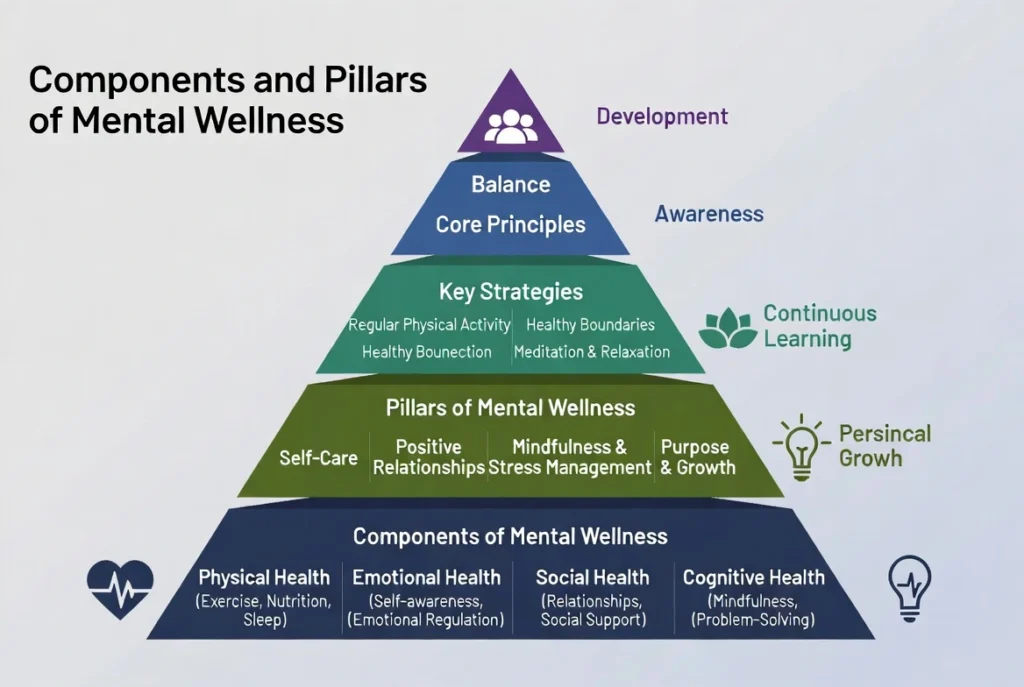
To build a strong house, you need a foundation. The same is true for your mind. There are five main pillars of mental wellness that I recommend to all my patients.
1. Emotional Regulation
This is your ability to manage big feelings. It doesn’t mean hiding them. It means not letting them drive the car. You feel the anger, but you don’t act on it immediately.
2. Cognitive Flexibility
Can you see a problem from a different angle? This component is vital for resilience. It allows you to find solutions instead of getting stuck in despair.
3. Social Connection
Humans are social animals. We need to feel like we belong. Having even one close friend can drastically improve your wellness scores.
4. Purpose and Meaning
Why do you get up in the morning? It could be your job, your family, or a hobby. Having a “why” makes the “how” much easier to handle.
5. Resilience
This is your “bounce-back” factor. It is the strength to keep going after a setback. Because life is unpredictable, this pillar is especially relevant for long-term health.
Mental Wellness in Different Areas of Life
Wellness doesn’t happen in a vacuum. It follows you from your living room to your office. Understanding what is mental wellness in the workplace can change your entire career trajectory.
Many modern companies now offer “wellness days.” These allow employees to recharge before they burn out. This is a smart move. When staff members are mentally well, they are more creative and focused.
Mental Wellness for Students and Youth
For younger people, the pressure to perform is immense. What is mental wellness for students? It often looks like a balance between grades and social life.
Schools that prioritize this help students build “grit.” This helps them handle academic failure without losing their self-worth. In the same way, mental wellness for kids starts with emotional literacy. Teaching a child how to calm down after a tantrum is a life skill.
The Physical-Mental Connection
It is also important to note the state of physical and mental wellness. They are two sides of the same coin. If you don’t sleep, your mental wellness drops.
If you are constantly stressed, your physical health suffers. Therefore, a holistic approach is necessary. You cannot truly have one without the other. This is why I always check my patients’ sleep hygiene during a mental health screening.
How to Build, Maintain, and Improve Mental Wellness

You aren’t born with a fixed amount of wellness. You can grow it. If you’re wondering how to improve mental wellness, the answer lies in small, daily habits.
Mental Wellness Activities and Habits
Start with “micro-habits.” For example, try five minutes of deep breathing every morning. This signals to your nervous system that you are safe.
Also, look at your “digital diet.” Are you scrolling through negative news all day? Reducing screen time is one of the fastest mental wellness techniques to lower anxiety.
Mindfulness and Self-Care
What is mental wellness and mindfulness? It is simply the act of being present. You don’t need a meditation cushion. You can be mindful while washing the dishes or walking the dog.
Furthermore, what is mental wellness and self care? It isn’t just bubble baths. Real self-care is sometimes doing the hard things. It might mean saying “no” to a social event because you need rest. It means making a doctor’s appointment you’ve been putting off.
Stress, Lifestyle, and Physical Health
There is a massive link between mental wellness and stress management. Chronic stress is the enemy of wellness. Using “box breathing” or progressive muscle relaxation can help.
Additionally, look at your movement. Mental wellness and physical health go hand-in-hand. Exercise releases endorphins. These are your body’s natural “feel-good” chemicals. Even a 15-minute walk can shift your mood.
Mental Wellness Support Options
Sometimes, self-help isn’t enough. That is perfectly okay. Knowing when to look for a mental wellness program is a sign of strength, not weakness.
Coaching vs. Therapy
What is a mental wellness coach? A coach focuses on the “now” and the “future.” They help you set goals and build better habits. They are great for people who feel “stuck” but aren’t in crisis.
In contrast, what is mental wellness therapy? Therapy often looks at the “past.” It helps you heal from trauma or manage clinical conditions. What is mental wellness treatment? This usually refers to a clinical plan designed by a psychiatrist or psychologist.
Assessments and Resources
You can use a mental wellness scale to track your progress. These are simple questionnaires that ask about your mood and energy.
Using a mental wellness assessment every few months helps you see patterns. Maybe you feel worse in the winter. Knowing this allows you to create a mental wellness strategy ahead of time. You can stock up on “light therapy” or plan more social outings.
Mental Wellness Awareness & Tools
The world is finally waking up to the importance of the mind. What is mental wellness month? In the United States, May is designated as Mental Health Awareness Month.
However, some organizations also recognize January as a time for “Mental Wellness.” It’s a great time to find a mental wellness book or attend a workshop.
Apps and Digital Courses
If you prefer tech, you might ask, what is the best mental wellness app? Options like Calm or Headspace are excellent for beginners.
Some people also ask about specific programs like the Noom mental wellness course pack. These tools use cognitive behavioral techniques to help you change your relationship with stress. They make the science of wellness easy to understand for everyone.
Frequently Asked Questions About Mental Wellness
What is mental wellbeing in short notes?
Mental wellbeing is your ability to handle life’s ups and downs. It involves feeling good and functioning well. It is an active state of health.
What is mental wellness in simple words?
It is the “fitness” of your mind. Just like you exercise your body to stay strong, you practice wellness to keep your mind resilient.
What is mental wellness and why is it important?
It is the foundation of a happy life. It is important because it affects your heart health, your relationships, and your ability to earn a living.
What is mental wellness and wellbeing?
These terms are often used interchangeably. They both refer to the positive state of your emotions, thoughts, and social connections.
What are the benefits of mental wellness?
Key benefits include lower stress, better sleep, and more energy. It also helps you recover faster from physical illness or emotional setbacks.
Conclusion: Starting Your Wellness Journey
We’ve covered a lot of ground today. From the mental wellness definition to practical daily habits, the message is clear. You have the power to influence your own mind.
In my clinical practice at Federa, I always tell my patients that wellness is a practice, not a destination. You don’t “finish” being well. You simply choose to prioritize your mind every day.
Start small. Pick one example of mental wellness we discussed and try it tomorrow. Maybe it’s a short walk or a deep breath. Over time, these tiny steps lead to a life of true flourishing. You deserve to feel well.
References & High-Quality Sources
- World Health Organization (WHO). (2025). Mental Health: Strengthening Our Response. A global perspective on wellness vs. illness.
- Centers for Disease Control and Prevention (CDC). (2026). About Mental Health. Understanding the link between physical and mental states.
- Global Wellness Institute. (2025). The Mental Wellness Initiative. Defining the pillars of a well mind.
- Harvard Health Publishing. (2026). The Connection Between Mental and Physical Health. Clinical insights into mind-body medicine.
- National Institutes of Health (NIH). (2026). Emotional Wellness Toolkit. Practical strategies for daily life.
Related Posts






MORE from Author
Read More As a physician, I regularly see patients who are utterly exhausted from poor sleep. When you are desperately scrolling online…
- Hey, there. Let's talk about something we all want but struggle to achieve: vibrant, long-term health. These days, figuring out…


 Every week in my clinical practice, patients ask me the same desperate question: "Doc, how do I actually prevent a…
 When patients visit my clinic, they frequently ask me, "Doc, what is a healthy lifestyle, really?" They feel completely overwhelmed…