How Many Hours of Sleep Do Women Need? Science-Backed Guidelines by Age, Hormones, and Lifestyle
The question of how much rest we truly require is one of the most persistent in modern wellness. While the standard advice has long been a flat “seven to nine hours for everyone,” emerging science suggests this doesn’t tell the whole story for women.
As Dr. Julian, I have spent decades analyzing the intersection of metabolic health and restorative rest. I recently worked with a patient, Sarah, a 34-year-old architect and mother of two. Sarah was getting seven hours of sleep—the “standard”—yet she felt chronically depleted, foggy, and irritable.
After adjusting her schedule to accommodate her hormonal cycle and increasing her window to eight and a half hours, her cognitive performance soared. Sarah didn’t have a medical disorder; she simply had a biological requirement that the “standard” guidelines ignored.
Women’s bodies navigate complex hormonal shifts, unique metabolic demands, and often a higher cognitive load. This guide breaks down the latest research on how many hours of sleep women need to thrive at every stage of life.
The Average Sleep Women Need Per Night
According to the CDC and the National Sleep Foundation, the baseline for all adults is between 7 and 9 hours. However, recent studies from the Sleep Research Center at Loughborough University suggest that women may actually need an average of 20 to 30 minutes more sleep than men.
This isn’t just about physical tiredness. It is about the “mental load.” Women tend to multitask more and use a larger percentage of their brains during the day for complex cognitive processing.
When the brain works harder, it requires more “clean-up” time during sleep. This is the process where the glymphatic system flushes out metabolic waste. If you aren’t hitting that extra 20-minute window, you may be accumulating a “sleep debt” that manifests as brain fog.
For most adult women, the target should be 7.5 to 9 hours. If you find yourself consistently needing an alarm to wake up, or if you feel the “afternoon slump” hitting hard at 2:00 PM, you likely need to push your bedtime earlier to hit that upper threshold.
Sleep Recommendations by Age for Women
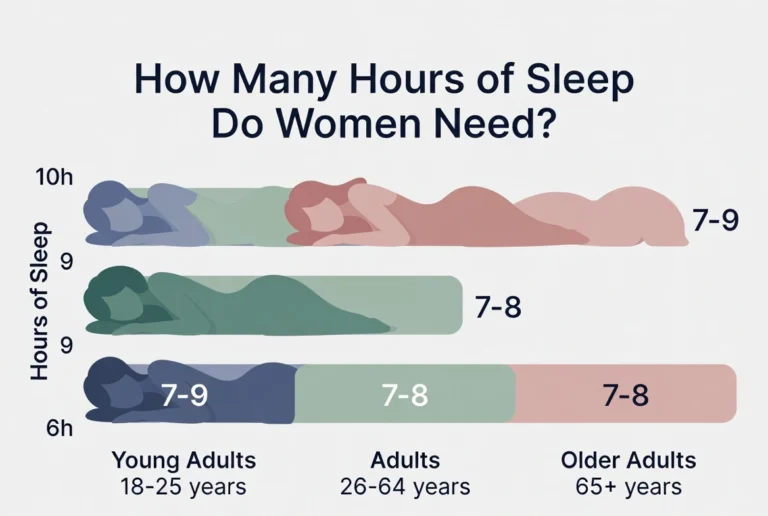
As a woman moves through different life stages, her circadian rhythm and sleep architecture shift. What worked in your 20s will likely not be sufficient in your 40s or 60s.
Sleep is not a static requirement; it is a dynamic one that responds to your body’s internal chemistry. Below is a breakdown of recommended hours based on age:
| Age Range | Recommended Sleep | Primary Influencer |
| 18–25 Years | 7–9 Hours | Social engagement & brain development |
| 26–39 Years | 7–9 Hours | Career stress, pregnancy, & young children |
| 40–60 Years | 7–8 Hours | Perimenopause & hormonal decline |
| 60+ Years | 7–8 Hours | Melatonin reduction & health maintenance |
In your 20s, the brain is still refining its neural pathways, requiring deep, consistent rest. By your 40s, the decline in estrogen and progesterone can make sleep more fragmented.
In my practice, I find that women in their 40s often report “waking up at 3:00 AM.” This isn’t necessarily a need for less sleep but a sign that the quality of sleep is being interrupted by shifting hormones, making a 7.5-hour target even more critical for recovery.
Do Women Need More Sleep Than Men?

The comparison between male and female sleep needs is one of the most researched topics in chronobiology. Data consistently shows that women report higher levels of daytime sleepiness and a greater “need” for sleep than their male counterparts.
The primary reason lies in cognitive load theory. Because many women are socially conditioned to manage multiple streams of information—household management, emotional labor, and career—their brains work in a more “multi-network” fashion.
When you use your brain more intensively during the day, it takes longer to recover at night. Furthermore, women are at a higher risk for sleep-disturbing conditions like restless leg syndrome, iron deficiency, and anxiety.
Research indicates that women may need roughly 11 to 20 minutes more sleep than men. While that seems small, that 20-minute deficit compounded over a week is over two hours of lost restorative time, which can significantly impact mood and metabolic health.
Why Women Sometimes Need More Sleep
To understand sleep, you must understand the endocrine system. Estrogen and progesterone are not just for reproduction; they are powerful sleep modulators.
Progesterone is often referred to as the “sleepy hormone” because it has a sedative effect on the brain. When progesterone levels drop—such as right before a period or during menopause—sleep quality often plummets, leading to insomnia or frequent awakenings.
Estrogen plays a role in regulating body temperature and REM sleep. When estrogen is low, women may experience night sweats or “hot flashes,” which fragment the sleep cycle and prevent the body from entering the deeper, more restorative stages of sleep.
Cortisol, the stress hormone, also interacts differently with female biology. High stress can lead to “tired but wired” syndrome, where you feel exhausted but cannot shut your mind off at night, a common complaint among my female patients.
How Many Hours of Sleep Do Women Need During Their Period?
The menstrual cycle is a four-week biological rollercoaster. During the luteal phase (the week before your period), progesterone levels rise and then sharply drop.
This drop can cause a significant decrease in REM sleep and an increase in body temperature. For many women, this results in “period insomnia” or extremely vivid, disruptive dreams.
During the actual days of menstruation, the body is dealing with physical pain (cramping) and lower iron levels. It is perfectly normal, and even recommended, to aim for 8.5 to 9.5 hours during your period.
I often tell my patients to “listen to the fatigue.” If your body is asking for an extra hour of sleep during your period, it’s not laziness; it’s a biological requirement for physical repair and inflammation management.
How Many Hours of Sleep Do Pregnant Women Need?
Pregnancy is perhaps the most demanding physical state a human can experience. The metabolic cost of growing a person is equivalent to running a permanent marathon.
A massive surge in progesterone causes intense daytime sleepiness. Women in this stage often need 9 to 10 hours of sleep plus daytime naps to function.
| Trimester | Sleep Needs | Common Challenges |
| First | 9–10 Hours | Progesterone surge, morning sickness |
| Second | 8–9 Hours | Heartburn, leg cramps |
| Third | 8–9 Hours + Naps | Frequent urination, physical discomfort |
During the third trimester, the physical discomfort of the growing belly and frequent trips to the bathroom make sleep fragmentation inevitable. In this stage, the total hours are less important than “getting it where you can get it,” meaning naps are a vital tool for health.
How Much Deep Sleep Do Women Need?
Sleep isn’t just about the quantity of hours; it’s about the quality of the stages. Deep sleep (Stage 3) is when the body repairs tissues, builds bone and muscle, and strengthens the immune system.
Most adult women need about 1.5 to 2 hours of deep sleep per night. This usually accounts for about 20% of your total sleep time. If you use a wearable tracker and see that you are only getting 45 minutes of deep sleep, your body isn’t fully recovering.
Factors like alcohol consumption, late-night snacking, and blue light exposure can “rob” you of deep sleep even if you are in bed for eight hours. Women specifically need this deep sleep to regulate the hormones that control hunger and stress.
REM (Rapid Eye Movement) sleep is equally important for emotional processing. Because women are statistically more prone to anxiety and depression, getting that final 90-minute REM cycle in the early morning hours is critical for mental health.
Is 6 Hours of Sleep Enough for a Woman?
The short answer is almost never. While some people claim to be “short sleepers,” research shows that less than 1% of the population carries the gene that allows them to function optimally on six hours or less.
For most women, consistently getting only six hours of sleep leads to:
- Hormonal Imbalance: Increased cortisol and decreased thyroid function.
- Weight Gain: A decrease in leptin (the fullness hormone) and an increase in ghrelin (the hunger hormone).
- Cognitive Decline: Reaction times and decision-making abilities equivalent to being legally intoxicated.
In my clinic, I’ve seen that chronic short-sleeping in women is a leading “silent” cause of insulin resistance. If you are trying to lose weight or manage your mood, six hours is simply not enough to support the necessary chemical reactions in your body.
Is It Normal for Women to Sleep 10 Hours?
While “oversleeping” can sometimes be a sign of underlying issues like depression or anemia, there are times when a 10-hour window is perfectly healthy and normal.
If you have just completed an intense week of travel, are recovering from an illness, or are in the first trimester of pregnancy, 10 hours of sleep is your body’s way of catching up on a massive “sleep debt.”
However, if you are consistently sleeping 10 or 11 hours and still feeling exhausted during the day, this is a red flag. It could indicate sleep apnea (which is often underdiagnosed in women), thyroid issues, or clinical depression.
It’s about the “restorative” nature of the sleep. If 10 hours leaves you feeling refreshed, it was likely a recovery phase. If 10 hours leaves you feeling “drugged” or heavy, it’s time to consult a healthcare professional.
How Sleep Affects Weight, Hormones, and Mental Health
If you are trying to lose weight, your sleep schedule is just as important as your gym schedule. Sleep deprivation causes your body to hold onto fat by spiking cortisol, which signals the body to store energy in the abdominal area.
Sleep also regulates the “hunger hormones”:
- Leptin: Tells your brain you are full. It drops when you are sleep-deprived.
- Ghrelin: Tells your brain you are hungry. It spikes when you are sleep-deprived.
This is why you crave high-sugar, high-carb foods after a bad night of rest. Your brain is searching for a quick energy hit to compensate for the lack of cellular recovery.
Mentally, sleep is the period when your brain processes the day’s emotions. For women, who often navigate high-stress social and professional roles, this emotional processing is vital for preventing burnout and maintaining resilience.
How to Improve Sleep Quality for Women
Improving sleep isn’t just about spending more time in bed; it’s about making that time count. Here are three practical tips specifically for female biology:
- Magnesium-Rich Foods: Magnesium is a natural muscle relaxant and helps regulate the nervous system. Dark leafy greens, pumpkin seeds, and almonds are excellent choices for a late-afternoon snack.
- Morning Light Exposure: Get 10–15 minutes of natural sunlight within an hour of waking. This “sets” your master circadian clock and ensures your body starts producing melatonin at the right time in the evening.
- Consistency Over Duration: Going to bed at 10:00 PM and waking at 6:00 AM every day is much better for your hormones than sleeping 5 hours during the week and 12 hours on the weekend. The “catch-up” sleep model actually creates more hormonal stress.
Frequently Asked Questions
How many hours should females sleep?
Most adult females should aim for 7.5 to 9 hours of sleep per night. Due to hormonal fluctuations and high cognitive loads, women often require slightly more rest than men to feel fully restored.
How many hours of sleep do adults need?
The general recommendation for adults is 7 to 9 hours. However, individual needs vary based on activity level, health status, and genetics.
How many hours of sleep do men need?
Men typically need 7 to 8 hours of sleep. While the baseline is similar to that of women, men often require slightly less sleep for cognitive recovery due to differences in brain network utilization.
Do women really need more sleep than men?
Yes, multiple studies suggest women need about 20 minutes more sleep than men. This is primarily attributed to women’s brains being “wired” for more complex multitasking, which requires a longer period of neural recovery.
How many hours of sleep do women need in their 20s?
Women in their 20s should aim for a solid 8 to 9 hours. In this decade, the brain and body are still finalizing development, and high levels of social and professional activity require significant recovery time.
Conclusion
Understanding how many hours of sleep a woman needs is not just about counting time; it is about honoring the unique biological architecture of the female body. As we have explored, the “standard” seven hours often falls short for women due to the intricate demands of hormonal cycles, higher cognitive loads, and the physical toll of life stages like pregnancy and menopause.
In my work with patients like Sarah, the most profound changes happened when they stopped viewing sleep as a luxury and started treating it as a non-negotiable metabolic requirement. When you give your brain that extra 20 to 30 minutes of “clean-up” time, you aren’t just avoiding tiredness—you are actively protecting your hormonal balance, your mental health, and your long-term cognitive clarity.
If you are currently struggling with exhaustion, start by extending your sleep window by just 15-minute increments this week. Use the 10-5-3-2-1 rule to quiet your nervous system, and pay close attention to how your needs shift during your menstrual cycle. By aligning your rest with your biology rather than a generic standard, you can finally move from a state of chronic depletion to one of true, vibrant vitality.
References

Related Posts






MORE from Author
Read More Just last week, a patient named Sarah walked into my clinic carrying three different boxes of popular gut biome tests.…
 Recently, a frustrated patient named Mark visited my public health clinic. He handed me an expensive, beautifully packaged at-home stool…


- Have you ever felt constantly exhausted and painfully bloated after normal meals? Recently, a patient named Sarah sat in my…
 It's scary to wake up in the middle of the night and not be able to move or talk. People…