
Have you ever woken up from a wild, vivid dream and immediately wondered, exactly what is REM sleep? You are certainly not alone. Many of my clinic patients ask me this exact question when they feel exhausted every morning.
Last week, a stressed 35-year-old patient named Mark sat in my office. He felt constantly fatigued despite spending eight hours in bed. Consequently, I showed him his wearable tracker data and explained the vital importance of sleep quality.
Therefore, I decided to write this comprehensive guide to help you finally understand your nightly rest. We will thoroughly explore what REM sleep is, its meaning and benefits, and how it completely heals your brain. Let us dive right into the incredible science of your nightly slumber!
TL;DR — Quick Answer
If you just need a fast summary, here are the most important facts about this crucial sleep phase:
- Definition: REM stands for Rapid Eye Movement. It is a highly active brain stage where intense dreaming occurs.
- Timing: It first happens about 90 minutes after you fall asleep. After that, it repeats every 90 to 120 minutes.
- Normal Amount: This stage should make up roughly 20% to 25% of your total nightly rest.
- Main Benefits: It is essential for memory consolidation, emotional regulation, and overall brain health.
What Is REM Sleep?
When patients ask me for a clear REM definition, I always start with the basic science. Rapid Eye Movement sleep represents the most mentally active phase of your entire night. Interestingly, your brain waves during this time look almost exactly like they do when you are fully awake.

Scientists first discovered this unique phase back in the 1950s. They noticed that sleeping patients would suddenly dart their eyes rapidly back and forth under closed eyelids. Because of this, they quickly realized that sleep was not just one long, passive state of unconsciousness.
So, what is the definition of REM sleep in a clinical sense? It is a distinct biological state characterized by total muscle paralysis, rapid breathing, and intense neurological activity. Furthermore, this specific phase acts as your brain’s nightly emotional therapy session.
Understanding what REM sleep means helps you realize why you sometimes wake up feeling emotionally drained or completely refreshed. Without this specific phase, your brain physically cannot process the complex events of your day. Therefore, it is arguably the most critical period for your mental health.
What Happens During REM Sleep?
You might frequently wonder, what does REM sleep do to your body while you are unconscious? First of all, your brain violently shifts into high gear. It actively begins sorting through every single piece of information you learned that day.
Next, you experience your most vivid, intense, and memorable dreams. Your amygdala, the emotional center of your brain, becomes highly active during this time. As a result, your dreams often feature strong emotions, bizarre scenarios, and intense problem-solving situations.
Most noteworthy, your brain intentionally paralyzes almost all of your major voluntary muscles. Doctors call this protective mechanism “muscle atonia.” Consequently, this temporary paralysis stops you from physically acting out your wild dreams and hurting yourself in bed.
Finally, your heart rate and breathing become much more irregular and rapid. Similarly, your blood pressure often spikes up and down unpredictably. Therefore, your cardiovascular system actually gets a very mild, completely natural workout while you rest.
Why Is REM Sleep Important?
Many exhausted patients ask me, is REM sleep good or bad for your health? I always tell them it is absolutely vital for their daily survival. If you do not get enough of it, your cognitive performance crashes immediately.
First, this phase completely drives your memory consolidation. It takes short-term facts from your day and permanently hardwires them into your long-term memory. Thus, students and professionals desperately need this phase to learn new, complex skills efficiently.
In addition, it acts as a powerful emotional reset button for your nervous system. It gently strips the painful, sharp emotions away from difficult daily memories. As a result, you wake up feeling much calmer and less anxious about yesterday’s stressful events.
Finally, it actively promotes massive neuroplasticity. This means it helps your brain physically grow new neural connections and repair damaged cellular pathways. In conclusion, answering what REM sleep is good for comes down to one simple fact: it keeps your brain youthful, sharp, and emotionally stable.
The 4 Stages of Sleep Explained
To fully grasp the overall sleep cycle, you must understand all the different phases of rest. Your brain cycles through four distinct stages multiple times every single night. As a result, looking at the entire process reveals exactly what stage REM sleep is.
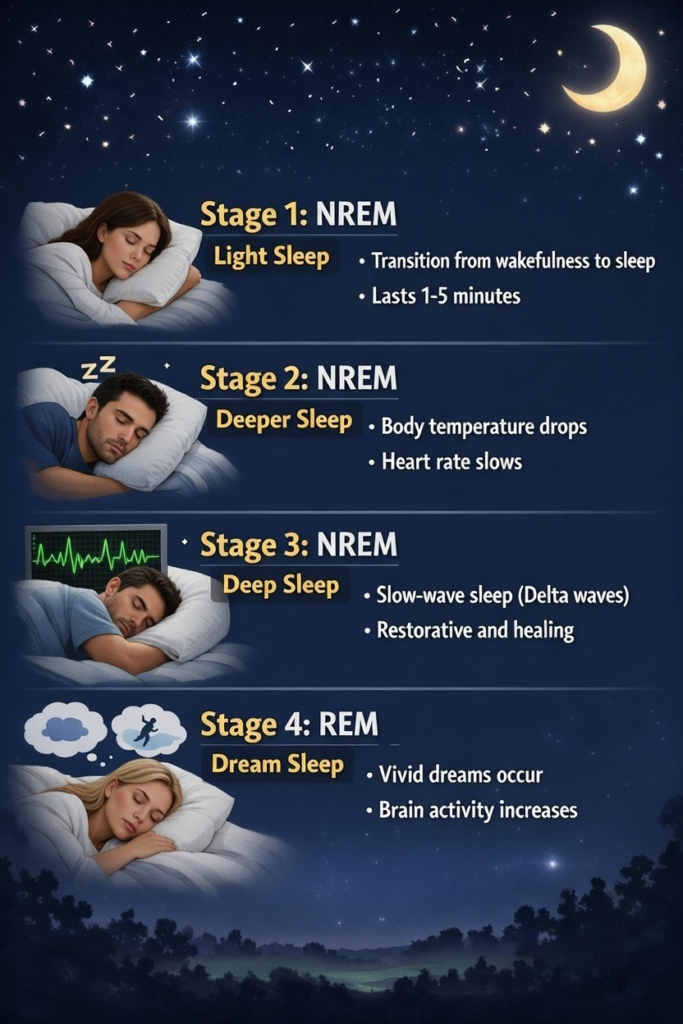
First of all, your night is divided into Non-REM (NREM) sleep and REM sleep. NREM contains three distinct steps that slowly guide you into deep unconsciousness. Afterward, your brain finally transitions into the rapid eye movement phase.
Here is a simple clinical table breaking down what are the 4 stages of sleep :
| Sleep Stage | Type | Primary Function |
| Stage 1 (N1) | Light Sleep | The brief transition phase between wakefulness and light slumber. |
| Stage 2 (N2) | Core Sleep | Heart rate drops; memory processing begins; body temperature lowers. |
| Stage 3 (N3) | Deep Sleep | Extreme physical tissue repair; immune system strengthening; bone growth. |
| Stage 4 (REM) | Active Sleep | Intense dreaming; emotional processing; complex memory consolidation. |
You cycle through these four stages roughly four to six times a night. Specifically, your rapid eye movement phases get much longer during the second half of the night. Because of this, waking up too early severely robs your brain of its most important mental recovery time.
REM Sleep vs Deep Sleep vs Core Sleep
In my sleep clinic, patients frequently show me their smartphone tracking data in complete confusion. They almost always ask me, what is the difference between REM and deep sleep? To truly optimize your nightly rest, you must understand how these distinct phases perform entirely different jobs.
First of all, to answer the common question, is REM sleep deep sleep? No, it absolutely is not. Deep sleep (Stage 3) acts as your body’s ultimate physical repair shop. During this specific time, your blood pressure drops significantly, and your brain waves slow down to a massive crawl.
Consequently, deep sleep repairs torn muscles, strengthens your immune system, and builds dense bone tissue. Conversely, the rapid eye movement phase focuses entirely on your mental and emotional restoration. So, if you wonder what is better, REM or deep sleep, the truth is you desperately need both equally.
Furthermore, many modern fitness trackers now use the term “core sleep.” What is core sleep exactly? It simply refers to light sleep, specifically Stage 2 of your cycle. While it sounds less important, core sleep actually makes up the vast majority of your night and helps regulate your baseline metabolism.
| Sleep Phase | Primary Focus | Brain Wave Activity | Typical Percentage of Night |
| Deep Sleep (N3) | Physical body repair and immune health | Extremely slow (Delta waves) | 15% to 20% |
| Core Sleep (N2) | Baseline metabolic regulation | Moderate with sleep spindles | 45% to 55% |
| REM Sleep | Mental, memory, and emotional repair | Highly active (Similar to awake) | 20% to 25% |
How Much REM Sleep Do You Need?
Determining exactly how many hours of REM sleep you need depends entirely on your specific age and health. However, healthy adults generally require about 90 to 120 minutes of this specific phase every single night. Therefore, if you sleep for eight hours, what percentage of REM sleep is normal?
Generally speaking, it should account for roughly 20% to 25% of your total time asleep. If your wearable device consistently shows you dropping below 15%, you are likely suffering from severe sleep deprivation. Consequently, your daily cognitive performance and emotional stability will decline rapidly.
In my medical practice, I always remind patients not to obsess over a single bad night. Your brain actually performs a phenomenon called “REM rebound.” If you miss this vital sleep phase on Tuesday, your brain will automatically force you into longer, more intense dreaming phases on Wednesday.
REM Sleep in Babies, Newborns, and Dogs
Many exhausted new parents ask me, what is REM sleep newborn behavior like? Interestingly, newborns spend a massive 50% of their total sleep time in this active dreaming phase. Because their young brains are developing at an explosive, unprecedented rate, they desperately need massive amounts of neuroplasticity.
Therefore, you will often see babies twitching, smiling, or making strange noises while completely unconscious. Similarly, pet owners frequently ask, what is REM sleep in dogs? Dogs also experience this same biological phenomenon.
When your dog suddenly twitches its paws or whimpers softly on the rug, it is actively dreaming. Just like humans, this critical phase helps animals consolidate their daily memories and learn new survival behaviors. Consequently, you should never aggressively wake a sleeping dog or baby during this active phase.
What Is REM Sleep Latency?
When I order a professional overnight sleep study for a patient, I carefully examine a metric called “sleep latency.” So, what is REM sleep latency exactly? It simply measures the exact amount of time it takes your brain to enter its very first dreaming phase after you fall asleep.
In a healthy adult, normal latency sits between 90 and 120 minutes. However, certain severe medical conditions drastically alter this normal timeline. For example, patients suffering from clinical narcolepsy often plunge directly into the rapid eye movement phase within just fifteen minutes.
Conversely, patients taking heavy doses of certain antidepressants might experience severely delayed latency. Furthermore, heavy alcohol consumption completely suppresses this vital stage during the first half of the night. As a result, your natural sleep architecture becomes entirely fragmented and unhealthy.
REM Sleep Behavior Disorder
Sometimes, the natural, protective mechanisms of your brain completely fail during the night. What is REM sleep behavior disorder (RBD)? It is a highly dangerous, complex neurological condition where the normal muscle paralysis of the dreaming phase suddenly stops working.
Consequently, patients physically act out their vivid, often terrifying dreams in the real world. In my clinic, I have seen patients severely injure themselves by punching walls or diving aggressively out of their beds. Furthermore, they frequently shout, swear, or physically attack their terrified sleeping partners while completely unconscious.
Primary Causes and Risk Factors
The exact biological causes of this terrifying disorder remain deeply tied to your brainstem. Specifically, the neural pathways that normally send the “paralysis signal” to your spinal cord physically degenerate. Most noteworthy, this condition frequently acts as an early warning sign for severe neurodegenerative diseases.
Medical research shows a massive clinical link between RBD and the eventual onset of Parkinson’s disease. In addition, it strongly correlates with Lewy body dementia. Therefore, if you suddenly begin acting out your dreams violently, you must immediately consult a board-certified neurologist.
Clinical Treatment and Management
Treating this specific disorder requires immediate, aggressive medical intervention to prevent severe physical injuries. First of all, doctors highly focus on completely modifying the patient’s bedroom environment. We strongly advise placing heavy mattresses directly on the floor and removing all sharp furniture.
Medication of REM sleep behavior disorder typically involves very specific neurological depressants. Frequently, we prescribe a high clinical dose of synthetic melatonin to naturally stabilize the sleep cycle safely. If melatonin fails, a prescription medication called Clonazepam (a strong benzodiazepine) effectively suppresses the violent nocturnal movements in nearly 90% of patients.
What Is REM Sleep on Apple Watch & Bellabeat?
Today, millions of people track their nightly rest using highly advanced commercial technology. So, what is REM sleep on Apple Watch or Bellabeat devices? These popular consumer wearables use sophisticated algorithms to estimate exactly which sleep phase you are currently experiencing.
Specifically, they rely heavily on measuring your heart rate variability (HRV) and your micro-movements via an accelerometer. Because your heart rate spikes unpredictably during vivid dreaming, the watch flags this specific data as active sleep.
However, you must completely understand their clinical limitations. While devices like the Apple Watch are fantastic for tracking baseline trends, they cannot perfectly measure brain waves like an authentic medical EEG. Therefore, you should use consumer wearables to spot general patterns, not to diagnose a serious clinical sleep disorder.
Signs You May Not Be Getting Enough REM Sleep
How do you actually know if you are severely lacking this vital mental recovery time? First of all, you will experience a massive, immediate decline in your short-term memory. You might constantly forget basic names, misplace your car keys, or struggle to learn simple new tasks at work.
Furthermore, a lack of this specific sleep stage severely impacts your emotional regulation. Consequently, you may find yourself feeling highly irritable, overly anxious, or deeply depressed for absolutely no logical reason. Finally, chronic deprivation actively leads to intense daytime migraines and severe mental brain fog.
How to Improve REM Sleep Naturally
If your tracker shows poor numbers, you can absolutely fix it without heavy prescription medications. First of all, you must fiercely protect your nightly sleep hygiene routine. You should completely avoid viewing bright blue light from your smartphone at least one hour before bed.
In addition, you absolutely must eliminate alcohol consumption right before sleeping. While a quick “nightcap” makes you fall asleep faster, it chemically destroys your brain’s ability to enter the rapid eye movement phase. Consequently, you spend the entire night trapped in unrefreshing, fragmented light sleep.
Finally, managing your daily stress heavily improves your nightly brain architecture. Practicing deep meditation or supplementing with high-quality magnesium bisglycinate deeply relaxes your central nervous system. As a result, your brain feels safe enough to plunge into its deepest, most restorative dreaming cycles.
When to See a Healthcare Professional
You should never ignore chronic, exhausting sleep disturbances for months on end. If you consistently wake up feeling completely unrefreshed despite sleeping eight hours, you must seek clinical help. Furthermore, chronic loud snoring strongly indicates obstructive sleep apnea, which constantly pulls you out of your dreaming phases.
Most importantly, if you or your partner notice violent kicking, punching, or shouting during the night, immediately contact a physician. This dangerous lack of muscle paralysis requires rapid, professional medical intervention. Your primary care doctor can quickly refer you to a specialized sleep clinic for a comprehensive overnight evaluation.
Frequently Asked Questions
Is REM sleep deep sleep?
No, it is an entirely different biological phase. Deep sleep physically repairs your muscles, bones, and immune system. Conversely, the rapid eye movement phase focuses entirely on healing your mind, processing complex emotions, and consolidating your daily memories.
Is REM sleep good for you?
It is absolutely vital for your daily mental survival. Without it, your brain physically cannot learn new information or regulate your stress hormones properly. Therefore, getting enough of this specific phase directly protects your long-term cognitive health and emotional stability.
How many hours of REM sleep do you need?
A healthy adult typically needs roughly one and a half to two hours of this specific dreaming phase every night. This amount generally represents about 20% to 25% of a full, healthy eight-hour sleep cycle.
What is a normal REM sleep percentage?
For most healthy adults, hitting the 20% to 25% mark of your total sleep time represents perfectly normal, healthy architecture. However, newborn babies frequently spend up to 50% of their night in this phase to support their explosive, rapid brain development.
Can you have too much REM sleep?
While rare, excessively high amounts of this sleep stage can sometimes indicate a clinical problem. For example, patients suffering from severe clinical depression or narcolepsy often experience unusually high amounts of this phase. If your tracker consistently shows numbers above 35%, you should consult a certified sleep specialist.
Conclusion
In conclusion, understanding exactly what happens inside your brain at night completely changes how you view your health. Rapid Eye Movement sleep is not just a time for wild, bizarre dreams; it is your brain’s ultimate survival mechanism. Deeply processing your daily emotions and permanently storing vital memories, it keeps your mind incredibly sharp.
Furthermore, intentionally protecting your nightly sleep architecture ensures you wake up feeling emotionally balanced and physically energized. By actively avoiding late-night alcohol, managing your daily stress, and maintaining a cool bedroom, you naturally boost your crucial dreaming phases. Consequently, your long-term cognitive health improves drastically.
Finally, never hesitate to seek professional medical guidance if your sleep quality suddenly deteriorates or becomes physically violent. Taking your nightly rest seriously is the absolute most important investment you can make for your future well-being. Therefore, prioritize your sleep tonight, and your brain will absolutely thank you tomorrow.
Evidence-Based References:
1. National Institute of Neurological Disorders and Stroke (NINDS) — Brain Basics: Understanding Sleep
2. Sleep Foundation — REM Sleep: What It Is and Why It’s Important
3. Mayo Clinic — REM Sleep Behavior Disorder (RBD)
4. Cleveland Clinic — Sleep Basics: REM & NREM Sleep Stages
5. Centers for Disease Control and Prevention (CDC) — Sleep and Sleep Disorders