
Normal Blood Sugar Level in Infants (Newborn to Toddler): Charts, Ranges, and What Parents Need to Know

Blood sugar levels in newborns can fluctuate dramatically in the first few hours of life—but what is actually normal, and when should parents begin to worry?
Just last week in the neonatal intensive care unit (NICU), I sat down with a mother named Sarah who was terrified because her newborn son’s glucose was reading at 45 mg/dL. She had gestational diabetes and was convinced her child was in immediate danger.
I had to gently explain that a normal blood sugar level in infants, particularly in the first 24 hours of life, looks vastly different from a normal level in an adult. Glucose is the primary fuel for a baby’s rapidly developing brain.
During pregnancy, a baby receives a constant, steady supply of glucose directly from the mother through the placenta.
Once the umbilical cord is cut, the newborn must suddenly transition to regulating their own glucose levels. This biological shift is massive, and it takes a little time for their tiny liver and pancreas to sync up.
This comprehensive guide will define the exact normal ranges by age, provide clear tracking charts, outline the warning signs of dangerous fluctuations, and explain exactly when you need to seek emergency medical care.
TL;DR
- Normal blood sugar in newborns typically ranges from 40 to 90 mg/dL (2.2–5.0 mmol/L) within the first 24 hours of life.
- Immediately after birth, a temporary drop in blood glucose is a completely normal physiological adaptation.
- After infancy, glucose levels stabilize closer to 70–140 mg/dL, depending on feeding schedules.
- Low blood sugar (neonatal hypoglycemia) is far more common than high levels in newborns and requires prompt feeding or medical attention to protect brain health.
What Is a Normal Blood Sugar Level in Infants?
Defining Infant Blood Glucose
Blood glucose refers to the concentration of sugar present in the bloodstream at any given time. This sugar is the absolute most critical energy source for a developing baby.
Unlike adults, babies have a disproportionately large brain compared to their body size. This means their brain demands a massive amount of glucose to function, grow, and build neural connections.
Understanding the normal range for blood sugar in infants is essential because both extremes—too high or too low—can disrupt this delicate neurological development. For an infant, “normal” is a moving target that changes almost hourly during their first days on earth.
Newborn Blood Sugar Normal Range (0–48 Hours)
Standard Clinical Ranges by Hour
The newborn blood glucose normal range is highly dynamic. When parents ask me what the normal glucose range for a newborn is, I always have to ask: “How many hours old are they?”
Below is the standard clinical range we use in the pediatric ward to assess whether a newborn is adapting properly to life outside the womb:
| Time After Birth | Normal Range (mg/dL) | Normal Range (mmol/L) |
| 0–4 hours | 40–60 | 2.2–3.3 |
| 4–24 hours | 45–80 | 2.5–4.4 |
| 24–48 hours | 50–90 | 2.8–5.0 |
As you can see, the acceptable newborn blood sugar normal range steadily climbs as the baby begins to feed, digest breast milk or formula, and actively regulate their own metabolic hormones.
Newborn Sugar Level Range Chart
Understanding the newborn sugar level range chart is crucial for alleviating new-parent anxiety. The chart visually demonstrates the “glucose valley” that occurs shortly after birth.
When observing newborn blood sugar level charts, you will notice that fasting levels (right before a feed) will naturally sit at the lower end of the spectrum.
Conversely, about an hour after a successful nursing or formula session, the baby’s glucose will peak. As long as the numbers stay within these established visual curves, the infant’s metabolic system is functioning exactly as nature intended.
Normal Glucose Levels for Infants (Beyond Newborn Stage)
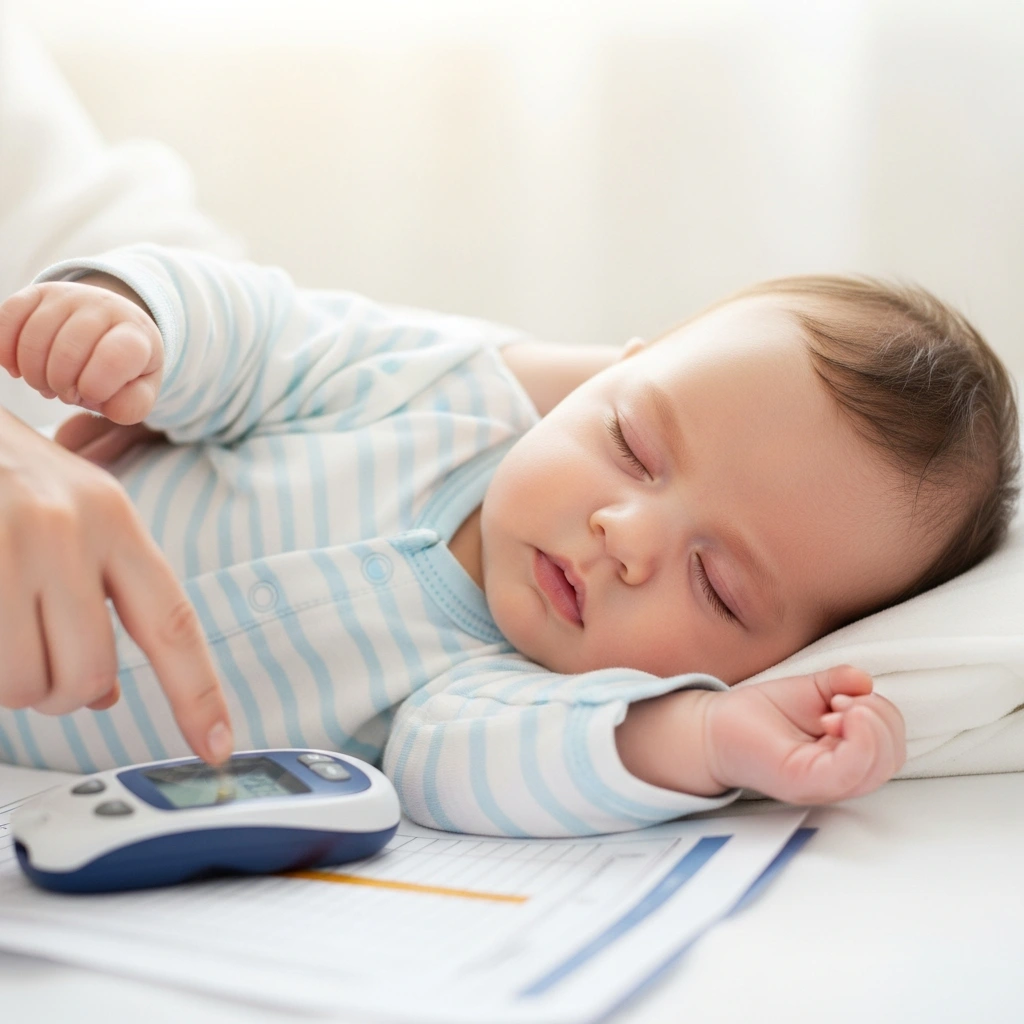
Fasting and Post-Feeding Levels (1 Month to 1 Year)
Once a baby graduates from the newborn stage, their metabolic system becomes much more robust and predictable. Looking at an infant’s blood sugar levels chart for a 6-month-old reveals numbers much closer to older children.
For babies between 1 month and 1 year of age, a typical fasting glucose (measured before their first morning feed) should sit comfortably between 70 and 100 mg/dL.
After a healthy feed of breast milk, formula, or early solid foods, it is completely normal for their blood sugar to temporarily rise up to 140 mg/dL. The baby’s pancreas will then release insulin to bring this number smoothly back to baseline.
Toddler Glucose Targets (1–2 Years)
As your baby transitions into a toddler, they become highly active. Walking, running, and playing require massive amounts of energy.
When parents ask about a baby’s blood sugar levels for a 1-year-old or older, the range is effectively set at 70–140 mg/dL. Fasting numbers should remain under 100 mg/dL, while post-meal spikes should rarely exceed 140 mg/dL.
What Are Normal Blood Sugar Levels in Children?
As we move past the toddler years, the metabolic guidelines align closely with adult standards. What are normal blood sugar levels in children aged 3 and older?
The general pediatric range dictates that a fasting blood glucose level should be maintained between 70 and 100 mg/dL.
After consuming meals or snacks, their blood glucose should remain under 140 mg/dL. If you are reviewing a “What is normal blood sugar by age chart,” you will see that from age 2 onward, the metabolic expectations remain remarkably flat and consistent through adolescence.
What Is a Normal Blood Sugar Level After Birth?
During the first 60 to 90 minutes immediately after delivery, a newborn experiences a sudden cessation of maternal glucose. Because they are still producing insulin at a high rate, their blood sugar naturally plummets.
Therefore, what is a normal blood glucose level after birth? It is perfectly normal for it to dip as low as 40 mg/dL during this window.
This drop triggers the baby’s liver to start breaking down stored glycogen into fresh glucose. Within 24 to 48 hours, as the baby learns to feed, this temporary drop resolves, and the glucose levels stabilize beautifully.
What Is High Blood Sugar in Newborns? (Neonatal Hyperglycemia)
Clinical Definition of Hyperglycemia
While we often worry about low sugar, high sugar can be equally dangerous. In neonatology, a high sugar level in a newborn baby is formally defined as a blood glucose reading consistently exceeding 150 mg/dL.
If a baby’s reading crosses 150 mg/dL, it indicates that their tiny pancreas is failing to produce enough insulin to push the glucose out of the bloodstream and into their cells.
Primary Triggers and Causes
Parents frequently ask, “What is high blood sugar in newborns caused by?” It is exceedingly rare in healthy, full-term infants.
It is most commonly seen in premature babies whose organs are simply too immature to produce insulin effectively. It can also be triggered by severe neonatal infections (sepsis), which cause profound physical stress.
Furthermore, in the NICU setting, if a sick newborn is receiving nutrition through an intravenous (IV) line, they can sometimes experience an accidental glucose overload, leading to temporary hyperglycemia.
Health Risks and Complications
Neonatal hyperglycemia is not something we take lightly in the hospital. When blood sugar is excessively high, it acts as a diuretic.
This forces the infant’s kidneys to produce large amounts of urine to flush out the excess sugar, leading to rapid, dangerous dehydration. If left unmanaged, this severe dehydration can increase the risk of intraventricular hemorrhage (brain bleeding) in highly fragile, premature infants.
Treatment usually involves adjusting IV fluids and, in rare cases, administering precise micro-doses of insulin.
Low Blood Sugar in Newborns (Neonatal Hypoglycemia)
While high blood sugar is rare, low blood sugar is arguably the most common metabolic issue we treat in the maternity ward. Neonatal hypoglycemia occurs when a baby’s glucose drops below safe physiological levels.
Clinical Definition of Neonatal Hypoglycemia
In the clinical setting, a newborn baby’s low sugar level diagnosis is typically made if the blood glucose reading falls below 40 mg/dL within the first 24 hours of life.
After 24 hours, any reading consistently below 50 mg/dL requires immediate intervention. Because the brain relies exclusively on glucose, prolonged low levels can lead to irreversible neurological damage, making rapid identification critical.
Common Causes of Low Sugar
Why does this happen? The most common cause is maternal diabetes (either gestational or pre-existing). If a mother has high blood sugar during pregnancy, the baby produces extra insulin to handle it.
Once born, the baby continues producing high levels of insulin, but suddenly lacks the mother’s sugar supply, causing a rapid crash. Other common causes include prematurity, low birth weight, and poor latching or feeding difficulties immediately after birth.
Symptoms to Watch For
Babies cannot tell us they feel weak, so we must rely on physical cues. The most classic symptom is jitteriness or severe tremors, especially in the hands and legs.
Other vital signs of a newborn baby with low sugar levels include profound lethargy (inability to wake for feeds), a weak or high-pitched cry, bluish skin (cyanosis), and a dangerously low body temperature. In severe, untreated cases, hypoglycemia can trigger neonatal seizures.
How to Increase Sugar Level in a Newborn Baby (Safe Management)
When a baby’s sugar drops, parents often panic, but the medical treatments are highly effective and fast-acting. As a pediatrician, I want to reassure you that we have clear protocols for how to increase the sugar level in a newborn baby safely.
First-Line Interventions (Feeding)
The absolute best and safest way to raise an infant’s glucose is through feeding. If the baby is awake and able to suck, we immediately encourage breastfeeding or expressing colostrum.
Colostrum is incredibly rich in nutrients and acts as a perfect, stabilizing energy source. If breastfeeding is not possible or the mother’s milk has not come in, supplementing with infant formula is the immediate next step.
Medical Treatment (Glucose Gel and IVs)
Sometimes, feeding isn’t enough, or the baby is too lethargic to swallow safely. In my practice, I frequently use a 40% oral glucose gel. We simply massage a precise dose of this sweet gel into the inside of the baby’s cheek.
The buccal mucosa (cheek lining) absorbs the sugar directly into the bloodstream within minutes, bypassing the stomach. If the baby’s levels remain dangerously low despite feeding and gel, the baby will be transferred to the NICU for an intravenous (IV) dextrose infusion to provide continuous, life-saving sugar directly into their veins.
Newborn Blood Sugar Protocol (Hospital Guidelines)
Not every single baby requires painful heel pricks to check their sugar. Hospitals follow a strict newborn blood sugar protocol to identify those truly at risk.
Screening High-Risk Babies
We selectively screen babies who fall into high-risk categories. This includes premature babies (born before 37 weeks), babies who are unusually large or small for their gestational age, and infants born to diabetic mothers.
These infants will have their glucose checked usually within 30 to 60 minutes after birth, and then before every subsequent feed.
Monitoring and Treatment Thresholds
The monitoring continues for the first 12 to 24 hours of life. If a baby has three consecutive normal readings before feeds, we generally stop the heel pricks.
However, if a baby hits our treatment thresholds (e.g., dropping below 40 mg/dL), we initiate the feeding and glucose gel protocols mentioned above. We do not discharge a baby until they prove they can independently maintain normal blood sugar levels for at least 24 hours.
Can Infants Have Diabetes?
When parents see us testing their baby’s blood sugar, a common, terrifying question arises: “Does my baby have diabetes?”
Rare but Possible: Neonatal Diabetes
While incredibly rare, it is biologically possible. However, infants do not get Type 1 or Type 2 diabetes. Instead, they can be born with a condition called Neonatal Diabetes Mellitus (NDM), which is a genetic mutation affecting insulin production.
It occurs in roughly 1 in 400,000 births. This condition can be transient (resolving on its own within a year) or permanent, requiring lifelong insulin management.
Signs of Newborn Diabetic Blood Sugar Levels
Newborn diabetic blood sugar levels are characterized by persistent, aggressively high glucose (often well over 200 mg/dL).
The baby will urinate constantly, requiring continuous diaper changes, and will suffer from severe dehydration. Furthermore, despite feeding constantly, the baby will experience poor weight gain, failing to thrive, because their body cannot utilize the calories without insulin.
Blood Sugar Levels by Age (Quick Chart)
To keep things simple for anxious parents, here is a quick summary chart answering the question: what is normal blood sugar by age chart?
| Age Group | Normal Range (mg/dL) | Notes |
| Newborn (First 48 Hours) | 40–90 | Fluctuates based on feeding and age in hours. |
| Infant (1 Month – 1 Year) | 70–140 | Fasting should be under 100; post-meal up to 140. |
| Toddler (1 – 2 Years) | 70–140 | Mirrors older pediatric and adult ranges. |
Is Glucose Good for a 6-Month-Old Baby?
Yes, glucose is absolutely essential for a 6-month-old baby. Their brains require massive amounts of it to fuel cognitive and motor development.
However, parents often ask, “Is glucose good for a 6-month-old baby?” in the context of feeding them sweets. The crucial distinction is the source of the glucose.
A baby should get all the glucose they need from the natural carbohydrates found in breast milk, formula, and early pureed foods like sweet potatoes or bananas. You should absolutely never give an infant refined sugar, juice, or sweetened glucose water, as this disrupts their metabolism and damages emerging teeth.
What Is a Normal Blood Sugar Level for a 2-Year-Old?
By the time your child is running around as a toddler, their metabolic system is fully mature. What is a normal blood sugar level for a 2-year-old?
It is practically identical to a healthy adult. A fasting morning check should read between 70 and 100 mg/dL. One to two hours after eating a meal, their levels may temporarily peak, but should reliably remain under 140 mg/dL.
Warning Signs Parents Should Never Ignore

Whether you have a newborn or a toddler, metabolic emergencies require fast action. Knowing the physical signs is your best line of defense.
Signs of Low Blood Sugar (Hypoglycemia)
- Uncontrollable shaking or jitteriness in the hands or jaw.
- Extreme lethargy; the baby is limp or impossible to wake for a feed.
- Sweating profusely, despite a normal room temperature.
- A weak, high-pitched, or distressed cry.
Signs of High Blood Sugar (Hyperglycemia)
- Unquenchable thirst and frantic feeding.
- Excessive, heavy, saturated diapers are occurring much more frequently than normal.
- Signs of severe dehydration include a sunken soft spot (fontanelle) on the head.
- Rapid, shallow breathing.
When to See a Doctor
If you are monitoring your child at home under medical guidance, immediate medical intervention is required if their blood sugar reads below 40 mg/dL or consistently stays above 150 mg/dL.
Do not wait. Additionally, regardless of what a glucose meter says, if your infant exhibits any neurological symptoms—such as seizures, unresponsiveness, or severe cyanosis (turning blue)—you must call emergency services or go to the nearest emergency room immediately.
Frequently Asked Questions (FAQs)
What is considered a dangerously low blood sugar level for a newborn?
In a clinical setting, a blood sugar reading below 40 mg/dL (2.2 mmol/L) within the first 24 hours of life is considered dangerously low (neonatal hypoglycemia). If a newborn’s glucose drops below this threshold, they require immediate intervention, such as feeding or oral glucose gel, to prevent neurological complications.
Can I give my baby sugar water to raise their blood glucose?
No, you should never give a baby sugar water, juice, or pure glucose water unless it is explicitly administered by a doctor in a hospital setting. The safest and most effective way to stabilize an infant’s blood sugar at home is through routine, on-demand feeding with breast milk or infant formula.
How long does it take for a newborn’s blood sugar to stabilize?
A healthy newborn’s blood sugar typically stabilizes within the first 24 to 48 hours after delivery. During this critical transitional period, their liver and pancreas learn to regulate hormones independently, and establishing regular feeding schedules helps maintain a consistent, normal baseline.
Does maternal gestational diabetes affect a baby’s blood sugar?
Yes, if a mother has gestational or pre-existing diabetes, her baby is at a significantly higher risk of experiencing a low blood sugar crash immediately after birth. The baby produces extra insulin in the womb to manage the mother’s high sugar, which leads to a rapid drop in glucose once the umbilical cord is cut.
What are the physical signs of high blood sugar in an infant?
While exceedingly rare in healthy full-term babies, high blood sugar (hyperglycemia) can present as unquenchable thirst, frantic feeding behavior, and excessively heavy, frequent wet diapers.
You might also notice signs of severe dehydration, such as a sunken soft spot (fontanelle) on the baby’s head, which requires immediate medical evaluation.
Expert Medical Perspective (MD Insight)
The transition from the womb to the outside world is the most metabolically demanding event a human being will ever experience. As a pediatrician, I constantly reassure parents that neonatal glucose regulation is incredibly dynamic.
Seeing a baby’s glucose level drop to 45 mg/dL in the first few hours of life can be terrifying, but it is often a normal part of their biological adaptation. Most early abnormalities are entirely temporary, highly treatable, and leave no lasting impact.
However, vigilance is key. Understanding the signs of hypoglycemia—such as jitteriness and lethargy—empowers parents to seek timely intervention. Early detection and simple treatments, like an extra feed or a small dose of glucose gel, are all it takes to protect your infant’s brain and ensure they thrive in those precious early days.
Authoritative References:
- American Academy of Pediatrics (AAP) – Clinical Report: Postnatal Glucose Homeostasis in Late-Preterm and Term Infants
- Children’s Hospital of Philadelphia (CHOP) – Hypoglycemia in Children
- World Health Organization (WHO) – Newborn Health Guidelines
- National Library of Medicine (PubMed) – Glucose Gel in Infants at Risk for Transitional Neonatal Hypoglycemia
Related Posts






MORE from Author
Read More As a physician specializing in exercise science and public health, I regularly consult patients who feel completely lost in the…
 Just last week, a 34-year-old patient named Clara sat in my clinic, feeling entirely overwhelmed by the modern fitness industry.…


 Hello, I am Dr. Kenji Sato, MD, specializing in sports medicine and performance optimization. In my sports clinic, I constantly…
- In my clinical practice as a physician focused on exercise science, I often tell patients that mastering fitness bench workouts…