Home Fitness Cardio: Best Equipment, Exercises, and Workout Plans for Beginners
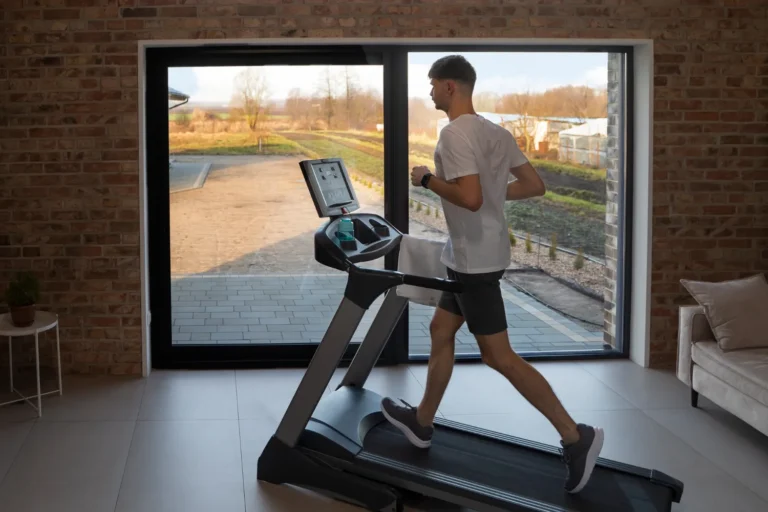
As a physician specializing in exercise science, I often hear patients say they don’t have time to commute to a gym. Many ask me how to build an effective Home Fitness Cardio routine that fits into a busy schedule.
Last year, I worked with Elena, a 45-year-old mother dealing with borderline hypertension and constant fatigue who felt overwhelmed by gym memberships and complicated equipment.
Instead of sending her to a gym, I created a simple home-based cardio plan she could do in her living room. We started with just 10 minutes of marching in place and basic bodyweight movements before breakfast.
Within three months, her blood pressure improved, her resting heart rate dropped, and she later added a small exercise bike to continue progressing.
Her experience highlights an important reality—you don’t need expensive equipment or a large gym to improve heart health. In this guide, I’ll cover the best home cardio exercises, equipment options, and practical routines to help you build cardiovascular fitness from home.
For foundational wellness strategies, explore our guide on what is a healthy living.
TL;DR
- Home cardio improves resting heart rate, accelerates weight loss, and builds muscular endurance.
- You can easily perform highly effective cardiovascular routines with or without expensive equipment.
- Top equipment choices include space-saving treadmills, stationary bikes, and low-impact rowers.
- Beginners should start with simple 5 to 10-minute bodyweight routines right in their living room.
What Is Home Fitness Cardio?
Home fitness cardio refers to cardiovascular exercises performed entirely at home. These actively improve heart health, muscular endurance, and daily calorie expenditure.
It encompasses any continuous movement that elevates your heart rate into your target aerobic zone. This ranges from highly structured sessions on a motorized treadmill.
It includes completely free, equipment-less routines utilizing your own body weight. Learn more about the comprehensive benefits of exercise for total body wellness.
Benefits of Cardio at Home
Performing your aerobic training at home eliminates the most common barriers to fitness. Travel time and gym anxiety disappear.
First, it profoundly improves cardiovascular health by strengthening the heart muscle. This allows it to pump blood more efficiently. Second, it supports sustainable weight loss by increasing your daily metabolic rate. It burns stored fat for energy.
Furthermore, regular aerobic exercise heavily boosts daily energy levels. It increases cellular mitochondrial density. Finally, it acts as a powerful tool for enhancing mental health. It releases endorphins that actively combat stress and clinical anxiety.
How to Improve Cardio Fitness at Home
Improving your aerobic capacity requires a methodical, progressive approach. Random bursts of intense exercise won’t work.
You must increase your workout duration gradually. Adding just two minutes to your routine each week yields massive long-term results. Once duration is established, you can safely add intensity. Use High-Intensity Interval Training (HIIT) to challenge your heart.
Most importantly, you must stay consistent. Exercising moderately three times a week is biologically far more effective than one exhaustive session a month. Always track your progress in a journal. This ensures you are continually moving forward.
How to Increase Cardio Fitness at Home
Scaling your routine safely is critical. This avoids joint pain and muscular burnout. Here is a progressive clinical approach.
Beginner Adaptations
If you are completely sedentary, your joints are not prepared for high-impact movements. Start with low-intensity activities. Try brisk walking around the house or gentle jumping jacks.
The goal here is simply to elevate your heart rate slightly. Avoid causing any orthopedic pain. New to fitness? Check out these fitness tips for beginners to build confidence safely.
Intermediate Progressions
Once your tendons and ligaments adapt to basic movement, you can increase the mechanical stress. Transition into jogging in place for extended periods. Use a skipping rope. These movements require more coordination. They force your heart to pump oxygen much faster.
Advanced Conditioning
For advanced individuals, the focus shifts to metabolic conditioning. HIIT circuits alternate between maximum effort sprints and short rest periods. Try rapid burpees.
This forces your body to adapt rapidly. This maximizes calorie burn. It dramatically increases your VO2 max. Explore our guide on fitness HIIT training for structured intervals.
Best Home Fitness Cardio Equipment
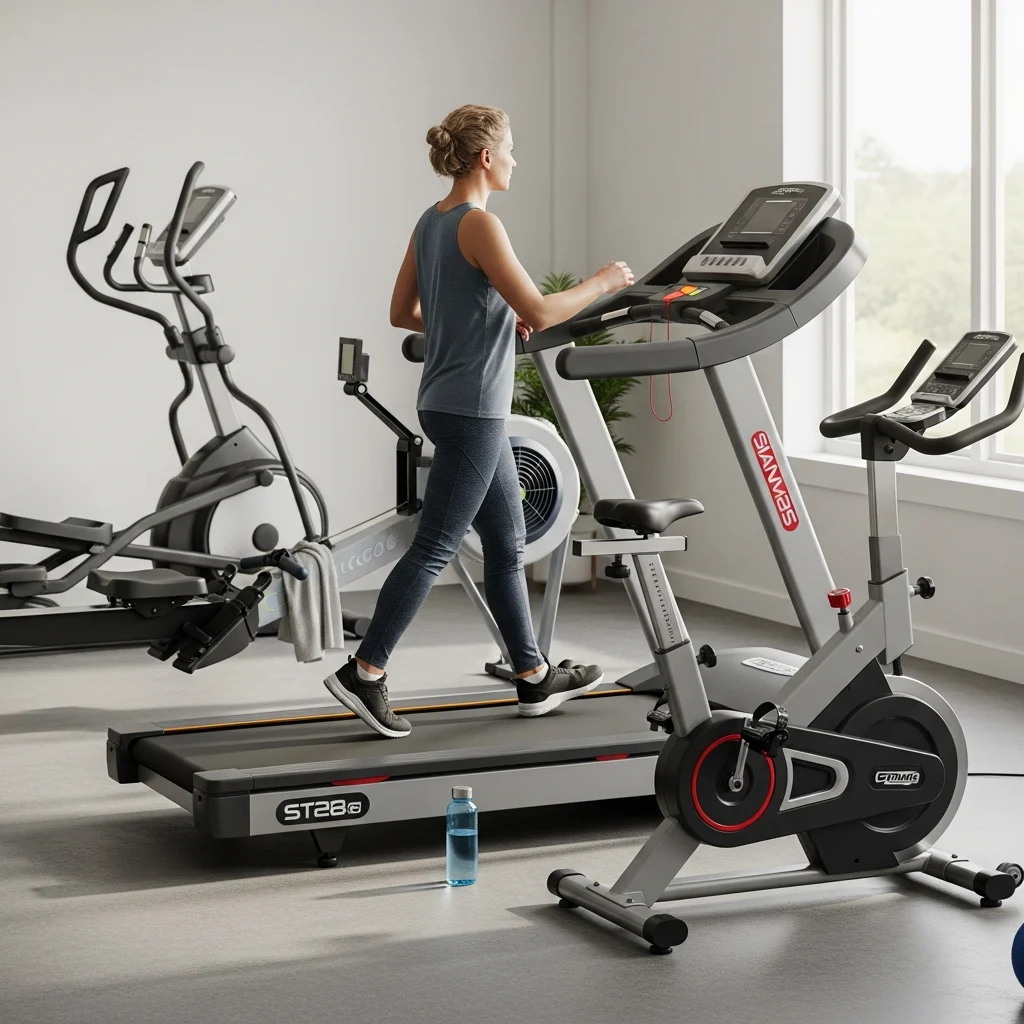
If you have the budget and space, investing in the right machinery makes your daily routine more engaging. Choosing the right machine depends entirely on your joint health and fitness goals.
Best Cardio Equipment for Home
The most popular options remain the foundational staples of any good gym. A motorized treadmill is excellent for mimicking natural walking and running biomechanics.
An exercise bike provides an incredible, low-impact lower-body workout. This is perfect for those with knee issues. A rowing machine is arguably the most efficient option.
It engages both your upper and lower body simultaneously. Impact stays virtually at zero. Ellipticals offer a similarly smooth, gliding motion for total-body engagement.
Best Budget Home Cardio Machine
You do not need to spend thousands of dollars to get a great workout.
A high-quality jump rope costs less than twenty dollars. It burns more calories per minute than almost any machine. Resistance bands can be used for rapid, high-repetition circuits.
These elevate your heart rate effectively. Compact, under-desk bikes are fantastic, inexpensive tools. They help you stay active while working from home.
Best Affordable Home Cardio Equipment
If you want slightly more structure without a massive footprint, there are excellent mid-tier options.
Plastic step platforms are incredibly cheap. They are perfect for classic step aerobics. This builds great calf and quad strength. Mini steppers fit easily in a closet. They provide a burning lower-body workout.
Foldable treadmills lack the powerful motors of commercial gym variants. But they are highly affordable. They are perfect for light jogging.
Best Rated Home Cardio Equipment
For those looking to invest in long-term health, premium machines offer unmatched durability.
High-quality treadmills feature advanced shock absorption. This protects your joints. Smart bikes come with integrated screens that stream live classes.
This provides the competitive motivation of a studio class. Connected fitness devices track your heart rate in real-time. This ensures you stay in the perfect fat-burning zone.
Best Home Gym Cardio Equipment
If you are building a dedicated garage gym, space and versatility are your primary concerns.
Look for multi-functional machines like fan bikes (assault bikes). These use air resistance to provide an infinitely scaling challenge. Space-saving equipment, like water rowers that stand upright when not in use, is perfect. They maximize your available square footage.
Featured Product: AeroSki Power Pro Home Fitness Cardio Machine
The AeroSki is gaining massive traction in the fitness community for a very specific reason: lateral movement.
Unlike bikes and treadmills that lock you into a forward-moving plane, the AeroSki provides a low-impact full-body workout. It uses a downhill skiing motion. This lateral training is incredible for strengthening the stabilizing muscles around your hips and knees. These are often neglected in traditional routines.
Argos Home Gym Equipment
For our readers looking at widespread retail options, Argos provides a highly accessible entry point.
They stock numerous budget-friendly options tailored for small apartments. Their entry-level cardio machines, such as magnetic resistance bikes and basic cross-trainers, are perfect for beginners. These help you test your commitment before buying premium gear.
Cardio at Home Equipment vs No Equipment
Understanding the trade-offs between buying gear and using your body weight helps you make an informed decision.
| Option | Clinical Pros | Clinical Cons |
|---|---|---|
| Equipment | More variety, highly measurable metrics, structured progression [[ACSM]] | Higher upfront cost, requires floor space, requires maintenance |
| No Equipment | Completely free, highly portable, builds functional body control [[CDC]] | Limited resistance options, can be hard on joints (jumping) |
List of Cardio Exercises at Home
You can build a world-class aerobic engine using nothing but gravity and your own body. Here are the staple movements you should master.
Jumping jacks are the ultimate full-body warm-up. They increase peripheral blood flow rapidly. Burpees are incredibly demanding. They combine a squat, a plank, and a jump to max out your heart rate. High knees force you to engage your lower core while driving your heart rate up.
Mountain climbers are fantastic for shoulder stability and abdominal endurance. Finally, skipping (even without a rope) mimics the plyometric benefits of jump rope training. This builds incredible calf strength and ankle stability. Explore more bodyweight fitness exercises you can adapt anywhere.
Cardio Exercises for Weight Loss at Home
If your primary medical goal is to reduce visceral belly fat, your routine must prioritize high energy expenditure.
HIIT workouts are scientifically proven to create an “afterburn” effect. This means your body continues to burn calories for hours after you stop exercising. Circuit training, where you move rapidly from one exercise to the next with zero rest, keeps your heart rate pinned in the fat-burning zone.
A heavy jump rope session is also unparalleled for rapid caloric expenditure. Pair these workouts with a healthy diet to lose weight for optimal results.
Cardio at Home (No Equipment)
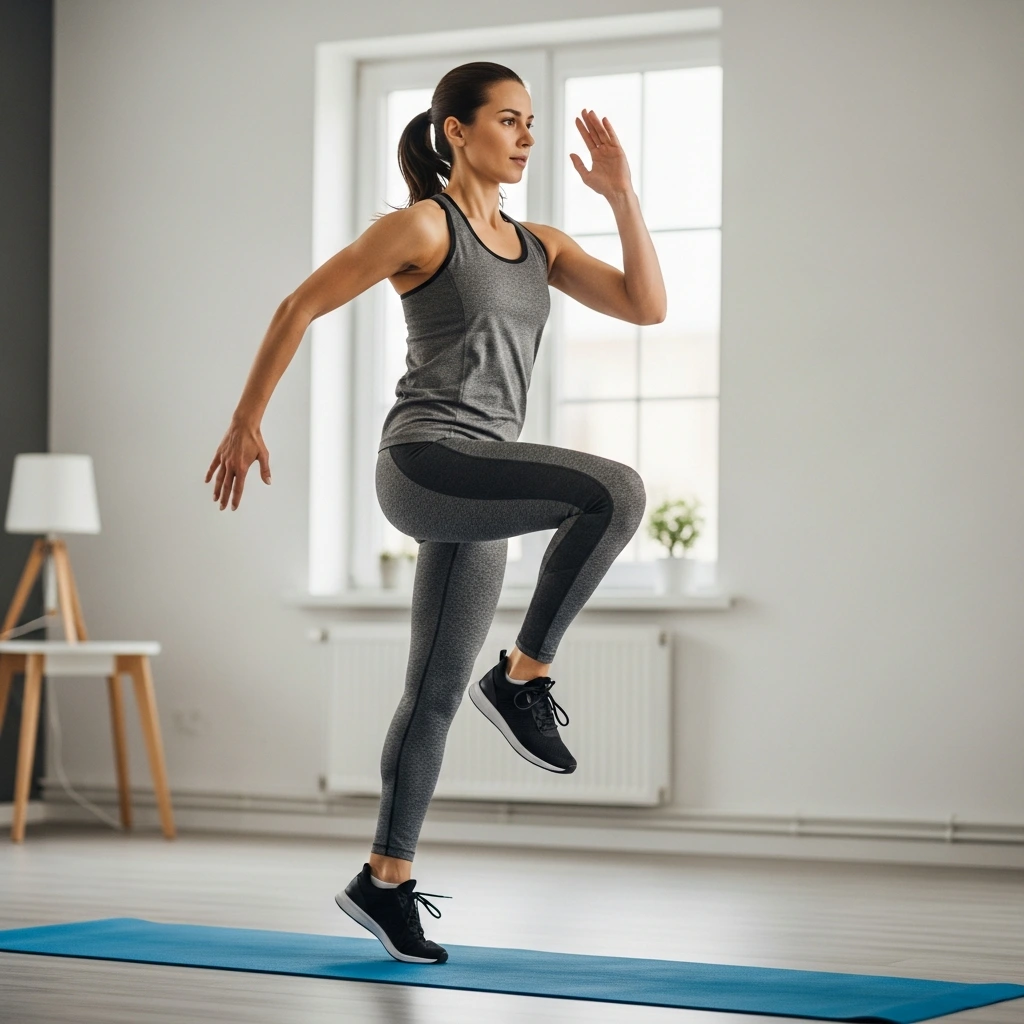
For those living in apartments or traveling, equipment-free routines are an absolute lifesaver.
Bodyweight circuits can be customized to any fitness level. Simply alter the speed and depth of the movements. Running in place, when done with high intensity and proper arm drive, is surprisingly effective.
Finally, guided dance workouts available online provide a fun, highly engaging way to stay active. You won’t feel like you are “working out.”
Cardio Exercises at Home (No Equipment for Beginners)
If you are severely deconditioned or recovering from an injury, you must avoid jumping entirely.
A simple routine should begin with a marching in place movement. Lift your knees as high as comfortable. Transition into a step touch. Step side to side while swinging your arms to engage your upper body.
Finally, use simple, rhythmic arm swings over your head. This safely elevates your heart rate without any lower-body impact.
5-Minute Cardio Workout at Home for Beginners
Consistency is built through small, easily achievable wins. Try this clinical 5-minute protocol every morning before your shower.
First, perform 1 minute of light jumping jacks to wake up your nervous system. Move directly into 1 minute of high knees (or marching) to elevate your heart rate. Next, do 1 minute of bodyweight squats to engage your large leg muscles. This pulls blood to your lower body.
Follow this with 1 minute of aggressive marching in place to keep the heart rate up. Finally, take 1 minute of complete rest. Focus on deep nasal breathing to bring your nervous system back to baseline.
Beginner Cardio Workout vs Gym Cardio Workouts
When deciding where to train, consider your psychological barriers as much as your physical goals.
Home workouts are undeniably more convenient. They totally eliminate the commute and the intimidation factor of a crowded gym. They operate at a low cost and require minimal setup. Conversely, gym workouts offer a higher variety of expensive machinery.
They provide the psychological benefit of being in a dedicated environment focused entirely on fitness.
Cardio Workouts at the Gym vs Home
The key difference lies in structure versus flexibility.
The gym provides highly structured equipment that isolates specific movement patterns. This is great for targeted rehabilitation. Home workouts, however, offer unmatched flexibility. You can exercise in your pajamas at 10:00 PM if that is the only time your schedule allows.
How to Build a Home Cardio Routine
A successful program balances different energy systems to prevent overtraining. Here is a balanced weekly template.
| Day | Activity Type | Primary Goal |
|---|---|---|
| Mon | HIIT (15 mins) | Maximize calorie burn and metabolic rate |
| Tue | Brisk Walking (30 mins) | Active recovery and joint lubrication |
| Wed | Complete Rest | Central nervous system recovery |
| Thu | Steady State Cardio (30 mins) | Build aerobic endurance (Zone 2) |
| Fri | Strength Training | Build muscle to support joints |
| Sat | Steady State Cardio (30 mins) | Sustained fat burning |
| Sun | Complete Rest | Total physical recovery |
For structured planning, see our fitness plan home resource.
Common Mistakes to Avoid
Many beginners sabotage their progress by making easily avoidable clinical errors.
Skipping your warm-up is a guaranteed way to pull a cold muscle or strain a ligament. Overtraining by doing high-intensity cardio every single day will rapidly lead to chronic fatigue.
This elevates cortisol (stress hormone) levels. Finally, using poor form—like letting your knees cave inward during a squat—will eventually result in severe orthopedic pain.
Safety Tips for Home Cardio
Safety must always precede intensity, especially when exercising alone without a trainer.
Always stay hydrated. Drink plenty of water before, during, and after your session to prevent cardiovascular drift. Use proper athletic footwear, even inside your house.
This provides necessary arch support and shock absorption. Most importantly, start slow. Your ego is your biggest enemy when beginning a new fitness program.
When to Upgrade to Equipment
You will eventually outgrow your basic bodyweight routine. Recognizing when to invest is key to continued progress.
If you hit a persistent plateau in progress and are no longer losing weight or gaining endurance, your body needs a new stimulus. If you need more intensity but your joints cannot handle more high-impact jumping, a low-impact machine is necessary.
Finally, if you simply want structured, highly trackable workouts, upgrading to a smart bike or treadmill is a wise medical investment.
Frequently Asked Questions
What is the best home fitness cardio?
The most effective approach is a balanced mix of high-intensity bodyweight exercises. Combine this with reliable equipment like a stationary bike or folding treadmill. This ensures consistent progressive overload.
Can I do cardio at home without equipment?
Yes, absolutely. Bodyweight exercises like burpees, mountain climbers, and aggressive high knees are highly effective. They push your heart rate into the maximum aerobic training zone.
How often should I do cardio at home?
For optimal cardiovascular health and disease prevention, most medical guidelines recommend engaging in moderate aerobic activity 3 to 5 times per week.
What is the best cardio for weight loss at home?
High-Intensity Interval Training (HIIT) and rapid circuit training are scientifically proven to be the most efficient methods. They burn visceral fat and elevate your daily metabolic rate.
Is a 10-minute home cardio workout actually effective?
Yes. For beginners, a focused 10-minute session consistently performed daily is highly effective. It lowers resting heart rate. It builds the necessary habit required for long-term fitness.
Conclusion
Transforming your cardiovascular health does not require an expensive gym membership. It does not require a massive time commitment. As we have explored throughout this guide, building an effective home fitness cardio routine is entirely within your reach. This applies regardless of your current fitness level.
Whether you choose to invest in a space-saving treadmill, jump into high-intensity bodyweight circuits, or simply start with five minutes of daily marching, the medical benefits remain profound.
Regular aerobic exercise is the most powerful prescription available. It lowers blood pressure, reduces visceral fat, and protects your mental health.
Do not let the pursuit of the “perfect” workout prevent you from starting. The best fitness program is simply the one you can stick to consistently. Clear some space in your living room.
Lace up your shoes. Take that crucial first step toward a stronger, healthier heart today. For more strategies on how to stay healthy long-term, explore our wellness resources.
Medical References & Further Reading:
- CDC. Physical Activity Guidelines. cdc.gov/physicalactivity
- AHA. Home Exercise Benefits. heart.org
- WHO. Exercise Recommendations. who.int
- Harvard Health. Cardio at Home. health.harvard.edu
- Mayo Clinic. Safe Home Workouts. mayoclinic.org
- NIH. Exercise & Heart Health. nih.gov
- ACSM. Training Principles. acsm.org
- JACC. Home-Based Cardio Studies. jacc.org
- Circulation. HIIT Research. ahajournals.org
- ADA. Exercise & Metabolism. diabetes.org
Related Posts
MORE from Author
Read More As a physician specializing in exercise science and public health, I regularly consult patients who feel completely lost in the…
 Just last week, a 34-year-old patient named Clara sat in my clinic, feeling entirely overwhelmed by the modern fitness industry.…
 Hello, I am Dr. Kenji Sato, MD, specializing in sports medicine and performance optimization. In my sports clinic, I constantly…
- In my clinical practice as a physician focused on exercise science, I often tell patients that mastering fitness bench workouts…