Fitness Bench Workouts: Full-Body Exercises, Charts & Beginner Plans (2026 Guide)

In my clinical practice as a physician focused on exercise science, I often tell patients that mastering fitness bench workouts is one of the most effective ways to build strength safely at home. A simple adjustable bench can turn a small space into a highly functional training area while improving exercise form and movement control.
Recently, I worked with a 42-year-old patient dealing with chronic shoulder impingement and lower back pain. He had been trying to strength train at home using the floor and an unstable sofa, which led to poor lifting mechanics and ongoing discomfort.
After evaluating his movement patterns, I introduced a structured workout plan built around an adjustable bench. This allowed him to improve posture, safely increase his range of motion, and build muscle without pain.
Within two months, he experienced significant strength gains and reduced discomfort. In this guide, I’ll explain how to use bench workouts safely and effectively to improve strength, stability, and long-term fitness.
This comprehensive 2026 guide will teach you exactly how to utilize this essential piece of equipment. From beginner bodyweight movements to advanced hypertrophy circuits, we cover the exact protocols needed to maximize your physical potential safely and effectively.
For foundational movement guidance, see our fitness tips for beginners.
TL;DR: The Essentials of Bench Training
- A workout bench enables full-body strength training safely at home or in the gym.
- Best exercises include the bench press, Bulgarian step-ups, and incline push-ups.
- These routines are ideal for muscle gain, fat loss, and beginner conditioning.
- Utilizing adjustable angles (incline/decline) significantly improves muscle targeting.
What Are Fitness Bench Workouts?
Fitness bench workouts are targeted strength training exercises performed utilizing a flat or adjustable bench. This essential equipment acts as a stable, elevated platform that supports your spine and allows for a full range of motion.
These workout bench exercises target the upper body, lower body, and core muscles far more effectively than floor-based routines. By elevating your body, you allow your joints to move freely, particularly the shoulders and elbows, during pressing movements.
Furthermore, a bench provides the necessary bracing and stability required to lift heavier resistance safely. It anchors your torso, preventing dangerous swaying and ensuring the target muscles do all the work. For more on foundational movement patterns, explore our benefits of exercise guide.
Benefits of Weight Bench Exercises
The primary advantage of utilizing a bench is unparalleled versatility. A single piece of equipment allows you to target every single muscle group in your body with clinical precision.
Muscle growth and improved strength are the most immediate benefits. Because the bench stabilizes your core and spine, your nervous system allows you to lift heavier loads, which is the primary driver of muscular hypertrophy [NIH: Muscle Adaptation Research].
Additionally, they offer incredible home workout convenience. Instead of purchasing multiple bulky machines, a single adjustable bench paired with dumbbells provides the exact same biomechanical benefits as a commercial gym setup.
For sustainable lifestyle integration, reference our how to maintain a healthy lifestyle framework.
Workout Bench Exercise Chart
To help you design an effective routine, use this workout bench exercise chart as a quick reference guide. It outlines how different movements target specific anatomy across various experience levels.
| Muscle Group | Recommended Exercise | Difficulty Level | Primary Benefit |
|---|---|---|---|
| Chest | Flat Bench Press | Beginner–Advanced | Overall pectoral mass |
| Legs | Bulgarian Step-ups | Beginner | Unilateral leg strength |
| Core | Decline Sit-ups | Intermediate | Deep abdominal activation |
| Arms | Tricep Bench Dips | Beginner | Triceps isolation |
| Back | Supported Dumbbell Row | Intermediate | Latissimus dorsi thickness |
Utilize this weight bench workout chart to ensure you are selecting movements that match your current physical capabilities and fitness goals. For heart-focused training, see our guide to best exercise for heart health.
Best Fitness Bench Workouts
When discussing the best mechanical weight bench workouts, you must focus on compound movements. Compound exercises recruit multiple muscle groups simultaneously, triggering the highest hormonal response for muscle growth and fat loss.
Let us break down the most effective bench free weight exercises in profound detail.
The Flat Bench Press
This is the undisputed king of upper-body development. Lying flat on the bench with your feet planted firmly on the floor creates a stable base of power. Lower the weight slowly to your mid-chest, keeping your elbows tucked at a 45-degree angle to protect your rotator cuffs.
Press the weight back up forcefully. This movement develops thick, dense pectoral muscles, strong anterior deltoids, and powerful triceps.
The Incline Dumbbell Press
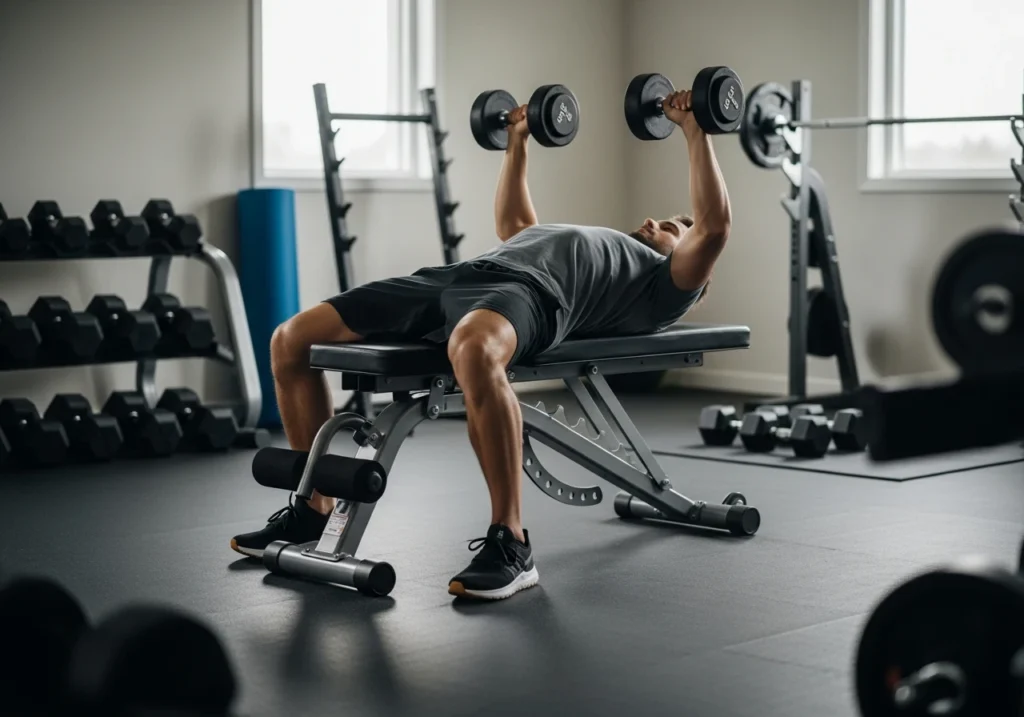
Setting your bench to a 30 to 45-degree incline shifts the mechanical tension to the clavicular head (the upper chest) and the front of the shoulders. When performing fitness bench workouts with weights at an incline, control is paramount.
Dumbbells require more stabilization than a barbell, which forces your deep shoulder stabilizer muscles to work overtime. This prevents muscular imbalances and builds a highly functional, aesthetic upper body.
The Bulgarian Split Squat
Do not assume a bench is only for the upper body. To perform this brutal but highly effective leg exercise, stand a few feet in front of the bench and rest the top of your back foot on the pad. Slowly lower your hips until your front thigh is parallel to the floor.
This exercise isolates the quadriceps and glutes of the front leg while aggressively challenging your core balance. For targeted leg development, see our fit legs workout resource.
Bench Dips
For arm development, bench dips are an incredibly accessible movement. Sit on the edge of the bench, place your hands next to your hips, and walk your feet out in front of you. Slide your hips off the bench and lower your body until your elbows reach a 90-degree angle, then press back up.
This strictly targets the triceps, the largest muscle group in your arms. For focused triceps work, reference our triceps fitness guide.
Single-Arm Dumbbell Rows
To build a thick, resilient back, the supported dumbbell row is essential. Place one knee and the same-side hand on the bench, keeping your back perfectly flat. Hold a dumbbell in your free hand and pull it up to your hip, squeezing your shoulder blade at the top.
The bench provides complete lower back support, making this the safest way to lift heavy weights for back development. For lower-back-focused routines, see our fitness lower back pain resource.
Weight Bench Exercises With Pictures (Visual Guide)
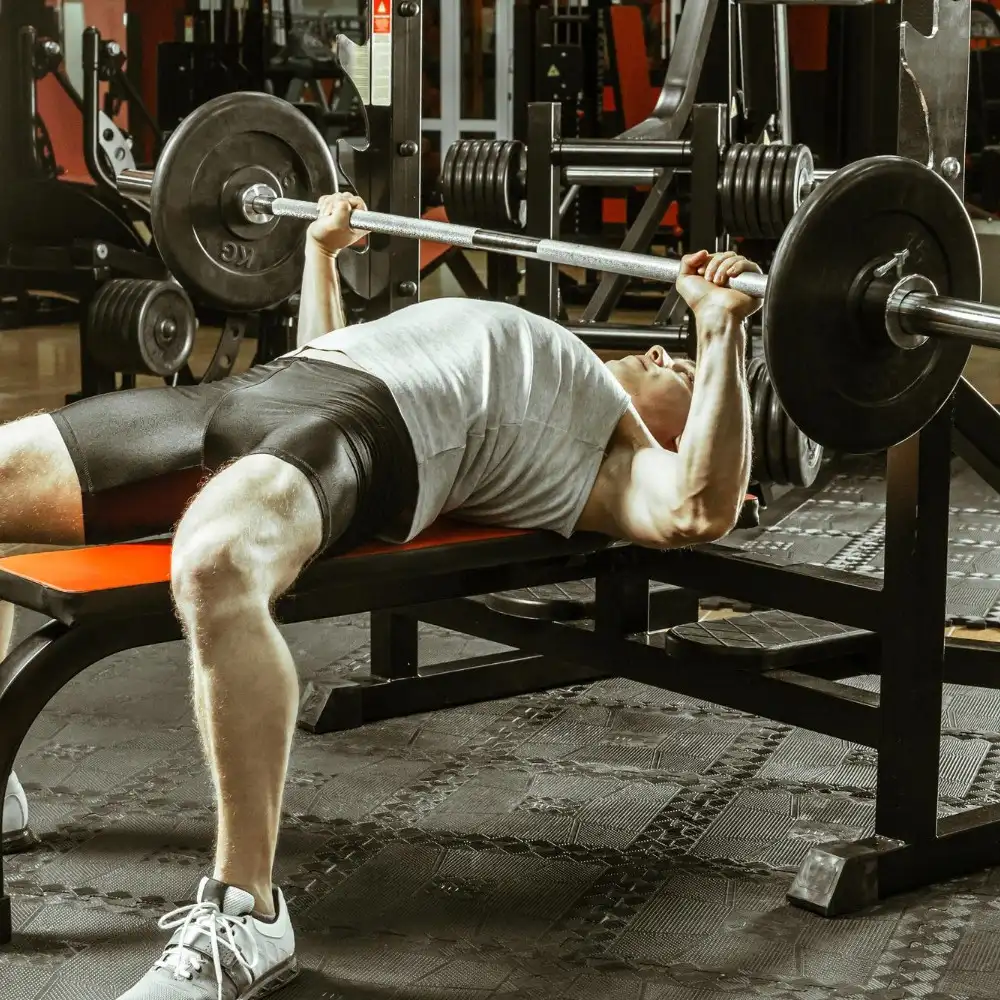
When referencing online guides for weight bench exercises with pictures, you must know what visual cues to look for to ensure proper form. Proper alt text and visual descriptions are critical for understanding biomechanics.
A correct bench press image will show the lifter with five points of contact: the head, upper back, and glutes firmly on the pad, with both feet driven flat into the floor.
Images of dumbbell rows should visually emphasize a perfectly neutral, flat spine. The neck should not be cranked upward; instead, the eyes should look straight down at the bench to prevent cervical strain.
Fitness Bench Workouts at Home
You do not need a massive garage to build a functional training space. Fitness bench workouts at home require incredibly minimal equipment—often just the bench itself and a single pair of dumbbells.
Small-space friendly workouts focus on transitioning quickly between exercises without moving around a room. You can perform seated shoulder presses, stand up for Bulgarian split squats, and lie down for chest presses all within a four-square-foot area.
These bench exercises at home completely eliminate the excuse of a daily gym commute. Storing a foldable bench under a bed or in a closet makes elite-level physical fitness accessible to anyone, anywhere. For a downloadable template, see our free fitness workout plan.
Adjustable Bench Workouts (Maximize Angles)
The true power of this equipment lies in adjustable bench workouts. Altering the angle of the backrest completely changes the biomechanical stress placed on your muscle fibers.
A flat angle evenly distributes weight across the entire pectoral muscle and anterior deltoids. It is the optimal position for moving the absolute maximum amount of weight for raw strength.
An incline angle (usually 30 to 45 degrees) heavily recruits the upper chest and the front shoulders. Conversely, a decline angle forces the lower chest and deep core muscles to stabilize the body, providing a unique growth stimulus.
Fitness Bench Workouts With Dumbbells
Dr. Sato frequently recommends fitness bench workouts with dumbbells over barbells for most non-competitive lifters. Dumbbells allow your wrists and shoulders to rotate naturally, preventing joint inflammation.
A standard dumbbell routine should always include the chest press, the single-arm supported row, and the seated shoulder press. These three movements cover the push-and-pull mechanics of the entire upper body.
Because each arm must lift its own weight independently, dumbbells completely eliminate muscular imbalances where a stronger dominant arm compensates for a weaker one.
Fitness Bench Workouts With Weights
When advancing to heavy fitness bench workouts with weights, you must understand the difference between barbell and dumbbell application. Barbells allow for the greatest overall load, making them superior for absolute strength.
However, moving heavy weights requires a strict progressive overload strategy. This means you must systematically increase the weight, sets, or repetitions over time to force the muscles to adapt and grow.
Never sacrifice your form simply to add more weight to the bar. Bouncing the weight off your chest or lifting your glutes off the pad severely compromises your spine and voids the benefits of the exercise.
Fitness Bench Workouts for Beginners
If you are new to lifting, fitness bench workouts for beginners must prioritize joint stability and neurological control before adding heavy resistance.
A highly effective beginner routine utilizes the bench for support rather than heavy lifting. Start with incline push-ups, placing your hands on the elevated bench to reduce the bodyweight load on your chest and shoulders.
Follow this with bodyweight bench squats—simply sitting down onto the bench and standing back up—to master hip-hinge mechanics. Finish with a very light dumbbell press to teach your arms how to stabilize free weights safely. For bodyweight alternatives, explore our bodyweight fitness exercises library.
Fitness Bench Workouts for Weight Loss
To utilize fitness bench workouts for weight loss, you must manipulate your rest periods to keep your heart rate elevated. The bench becomes a tool for high-intensity metabolic conditioning.
Circuit training is the most effective strategy here. Combine strength movements with cardiovascular bursts. For example, perform 10 heavy dumbbell presses, then immediately stand up and perform 20 rapid bench step-ups.
By keeping your rest intervals under 45 seconds, you force your body to rely on aerobic energy pathways. This burns massive amounts of calories while actively preserving your lean muscle tissue. For structured high-intensity protocols, explore our fitness HIIT training guide.
Fitness Bench Workouts (No Equipment Options)
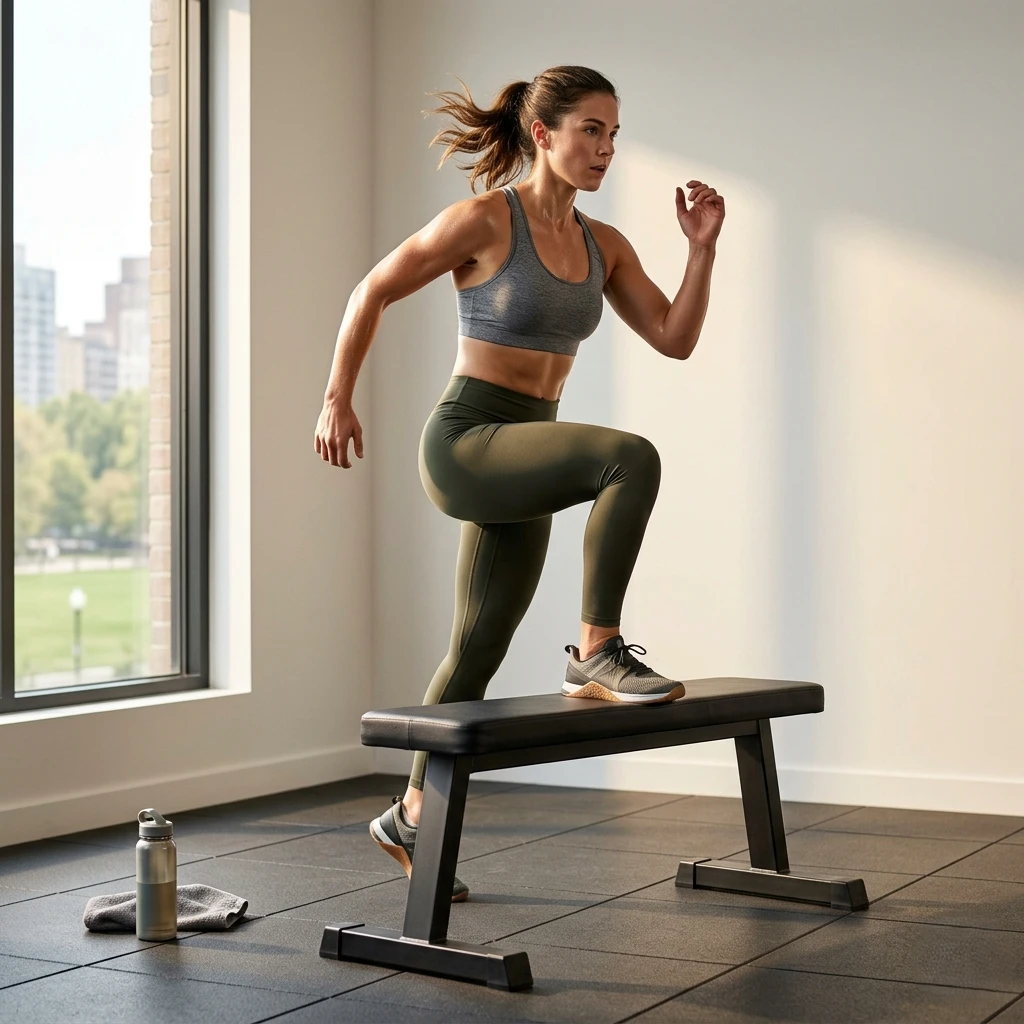
If you only have the bench and zero weights, fitness bench workouts with no equipment options are surprisingly grueling. Your body weight provides more than enough resistance if applied creatively.
Bench step-ups are incredible for cardiovascular endurance and leg power. Rapidly step up and down on the pad as if climbing a steep flight of stairs.
Combine these with incline push-ups for chest activation, and bodyweight dips off the edge for triceps. You can achieve a full-body, sweat-inducing workout using nothing but the bench and gravity.
Full Body Bench Workout Plan
To ensure balanced muscular development, follow this structured full-body bench workout. It targets every major anatomical zone safely and efficiently.
| Exercise | Sets | Repetitions | Rest |
|---|---|---|---|
| Flat Bench Press | 3 | 10 | 90 seconds |
| Bench Step-ups | 3 | 12 (per leg) | 60 seconds |
| Dumbbell Row | 3 | 10 (per arm) | 60 seconds |
| Bench Dips | 3 | 12 | 60 seconds |
Focus intensely on the mind-muscle connection during this routine. Lower the weights slowly over three seconds, pause, and explosively contract the target muscle. For targeted abdominal work, see our fitness abs exercises library.
Weekly Bench Workout Plan
Consistency is the ultimate driver of fitness results. Structuring a logical weekly schedule prevents overtraining and ensures adequate time for muscular repair [NIH: Recovery & Adaptation].
A 3-day split is ideal for most people. Perform the full-body routine on Monday, Wednesday, and Friday, allowing for complete rest and recovery on the days in between.
For experienced lifters, a 5-day advanced plan isolates specific muscle groups. You might train chest and triceps on Monday, back and biceps on Tuesday, legs on Wednesday, shoulders on Thursday, and a full-body circuit on Friday. For a long-term strategy, see our how to start a healthy lifestyle guide.
Common Mistakes to Avoid
The most common mistake Dr. Sato observes is poor posture on the bench. Allowing your lower back to excessively arch or letting your shoulders shrug forward drastically increases the risk of disc herniation and rotator cuff tears.
Using too much weight is an ego-driven mistake that ruins biomechanics. If you cannot control the weight during the downward eccentric phase, it is too heavy for you.
Finally, skipping warm-ups is a guaranteed path to joint injury. Always perform 5 to 10 minutes of light dynamic stretching before lying down under a heavy load.
How to Progress With Bench Workouts
Stagnation happens when you stop challenging your body. To progress, you must apply the principle of progressive overload consistently week after week.
Begin by gradually increasing the weight by just 2.5 to 5 pounds once you can easily complete your target repetitions with perfect form.
If you do not have heavier weights, increase the time under tension. Lower the weight much slower, add a two-second pause at the bottom of the movement, or safely adjust the angles of the bench to target weaker muscle fibers.
Safety Tips
From a medical and injury prevention standpoint, maintaining a neutral spine is your highest priority. Your head, upper back, and glutes must remain in constant contact with the pad during all lying movements.
Control your movements forcefully. Gravity should never pull the weight down; your muscles should resist the downward motion entirely.
Avoid unnecessary joint strain by keeping your wrists perfectly straight during pressing movements. Bending your wrists backward under a heavy dumbbell places immense, dangerous pressure on the delicate carpal bones. For comprehensive wellness integration, explore our healthy lifestyle habits resource.
Frequently Asked Questions
What exercises can you do on a workout bench?
A versatile workout bench allows you to safely perform a vast array of movements, including flat and incline chest presses, single-arm dumbbell rows, seated shoulder presses, triceps dips, and intense lower-body step-ups.
Are bench workouts good for beginners?
Yes. These workouts are exceptionally good for beginners because the physical structure of the bench provides crucial spinal support. This allows new lifters to safely learn proper biomechanics and movement patterns before attempting unsupported free-weight lifts.
Can you lose weight using a workout bench?
You can absolutely lose significant weight using this equipment. This is particularly true if you structure your routine as high-intensity circuit training by combining heavy strength movements with rapid cardiovascular exercises—like bench step-ups—using short rest intervals.
Do you need weights for bench workouts?
You do not explicitly need heavy dumbbells or barbells to get an effective workout. Bodyweight movements such as incline push-ups, explosive step-ups, and edge dips utilize your own body mass and gravity to build incredible strength and endurance.
What are the most common mistakes to avoid on a workout bench?
The most common mistakes include poor posture (such as excessively arching your lower back), using weights that are too heavy to control during the downward motion, and skipping your warm-up. Avoiding these errors is critical for preventing joint strain and spinal injury.
Conclusion
In my clinical practice, I often remind patients that you do not need a room full of expensive equipment to build a strong, functional body. A simple, sturdy weight bench is one of the most versatile tools you can use for safe and effective strength training.
Whether you’re working out in a small apartment with light dumbbells or training in a full gym with heavier weights, a bench provides important support and stability. This helps improve exercise form, protect your spine, and safely target major muscle groups.
I always encourage patients to focus on proper biomechanics before increasing weight. Consistent movement patterns, controlled progression, and good form are what lead to long-term results—not rushing the process.
By following a structured training plan and staying consistent, you can build strength, improve resilience, and support your long-term health for years to come.
Medical References & Further Reading:
- ACSM. Resistance Training Guidelines. acsm.org
- CDC. Strength Training Basics. cdc.gov/physicalactivity
- WHO. Physical Activity Guidelines. who.int
- PubMed. Angle-Specific Hypertrophy. pubmed.ncbi.nlm.nih.gov
- Journal of Strength & Conditioning Research. Bench Stability. jsc-journal.com
- NIH. Muscle Adaptation Research. nih.gov
- Harvard Health. Compound vs. Isolation. health.harvard.edu
- Mayo Clinic. Shoulder Safety. mayoclinic.org
- NSCA. Visual Learning in Strength Training. nsca.com
- Journal of Sports Science. Dumbbell Safety. tandfonline.com
- Spine Journal. Lifting Mechanics. spinejournal.org
- PubMed. HIIT for Fat Loss. pubmed.ncbi.nlm.nih.gov
Related Posts


MORE from Author
Read More As a physician specializing in exercise science and public health, I regularly consult patients who feel completely lost in the…
 Just last week, a 34-year-old patient named Clara sat in my clinic, feeling entirely overwhelmed by the modern fitness industry.…

 Hello, I am Dr. Kenji Sato, MD, specializing in sports medicine and performance optimization. In my sports clinic, I constantly…
- In my clinical practice as a physician focused on exercise science, I often tell patients that mastering fitness bench workouts…